









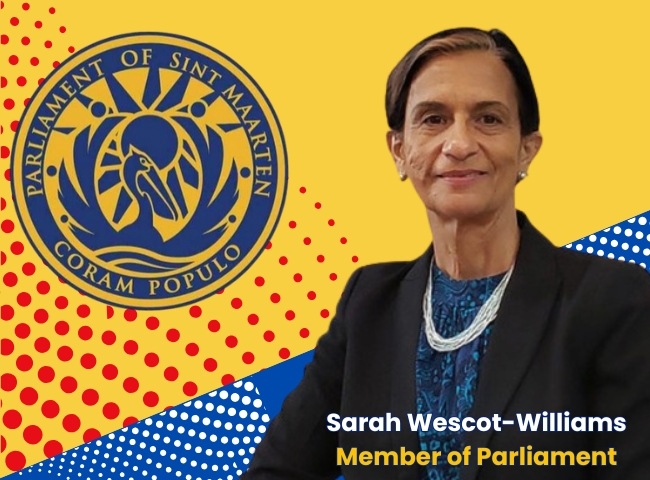



Philipsburg, Sint Maarten – On the occasion of the United Nations International Day of Older Persons, observed on October 1, President of Parliament Sarah Wescot-Williams called on government to view the growing longevity of Sint Maarten’s population not as a burden, but as an opportunity, particularly in addressing the persistent staffing shortages in the public sector.
This year’s UN theme, “The Age of Longevity: Rethinking Systems for Longer Lives,” calls on governments and societies to ensure that the additional years people are gaining translate into healthy, productive, dignified and equitable lives. “Rethinking systems is exactly what is needed,” Wescot-Williams said. “And here in Sint Maarten, we have a system that is in urgent need of rethinking: the way we fill vacancies in government.”
Wescot-Williams pointed out that the period between identifying a vacancy and actually filling the position is often so long that the government loses qualified candidates along the way. Meanwhile, the work piles up and the remaining staff are stretched thin.
Her proposal is that the government draw on experienced older persons, including former civil servants and other seasoned professionals, to serve as a bridge during that period, strictly voluntary. “Only if they agree, of course,” she stressed. “No one should be pulled out of a well-earned retirement. But many of our older persons are healthy, capable and willing, and they carry decades of knowledge about how the government and other institutions work.”
Under this approach, the work of a department would continue while the recruitment process runs its course, allowing the government to focus on attracting and bringing in new and young recruits. The arrangement offers a second benefit: when the new recruit arrives, the bridging professional can help with onboarding, passing on institutional knowledge and practical experience that no manual can fully capture.
“This is not about replacing young people. It is the opposite,” Wescot-Williams said. “It is about making sure that the door stays open for them, and that when they walk through it, someone experienced is there to help them find their way. That is how knowledge is transferred, and that is how we honor the contribution of our older persons.”
The President of Parliament noted that the UN recognizes that longer lives can generate a “longevity dividend” when people are supported to remain active and engaged. She encouraged the government to explore how such a bridging arrangement could be structured in practice, including the contractual, pension-related and budgetary aspects, so that it is fair to the persons involved and workable for the organization.
“Our older persons built this country,” Wescot-Williams concluded. “Many of them would welcome the chance to help build its future as well. Let us give them that opportunity, on their terms.”