















6,000+ participants unite around stronger island collaboration, as leaders call for finance and partnerships that reach islands ahead of pre-COP and COP31
28 September 2026: Island leaders, policymakers, researchers and practitioners from around the world came together at the eighth Virtual Island Summit, united by a shared message: island communities are already developing practical responses to climate, ocean and economic challenges, but stronger collaboration, finance and partnerships are needed to take those solutions further.
Held online from 15 to 17 September, the Summit brought together participants from across the Pacific, Caribbean, Europe, the Indian Ocean, the Arctic and beyond. This year’s event was structured around three themed days: Adapt to Change, Transform Systems and Mobilise Action. Across twelve sessions spanning coastal erosion, ocean governance, food and energy security, tourism and climate finance, discussions highlighted a common theme: while islands face unique vulnerabilities, they are also generating some of the most innovative and practical responses to today’s pressures.
Knowledge, Finance & Tuvalu’s pre-COP Leaders Event
Tuvalu’s Prime Minister, Hon. Feleti Penitala Teo, opened the Summit by discussing that Tuvalu will host a pre-COP leaders’ side event on 6 October, showcasing the Tuvalu Coastal Adaptation Project (TCAP), which he said has reclaimed approximately 15.3 hectares of land on Funafuti, the capital of Tuvalu. His message to leaders:
“Traditional knowledge must not sit at the margins of climate action. It must be at the centre of climate action…We must therefore invest in the people who carry that knowledge, connect generations and communities, and ensure that adaptation protects more than physical infrastructure.”
Mafalda Duarte, Executive Director of the Green Climate Fund (GCF), challenged conventional narratives around islands:
“Islands are often described as being on the front line of climate change, and that is absolutely true, but they are also home to some of the world’s deepest experience in adapting to change.”
Speaking about the wider adaptation finance system, Duarte said small island states receive just 0.2% of global international adaptation finance, even though more than 34 million islanders have been hit by storms, floods or drought in the past decade. She noted that nearly a quarter of GCF’s projects are in small island developing states, and pointed to Tuvalu as an example of what targeted finance can achieve: a $36 million GCF commitment made a decade ago helped unlock a further $67.9 million from Australia, New Zealand and the Asian Development Bank to aid resilience efforts.
The theme carried through to the final day of the event, when Mobilising Ocean-Climate Finance at COP31 asked what it would take for ocean priorities to receive the same urgency and funding as other climate issues. Rachel Kyte, UK Special Representative for Climate, called for debt pause clauses after extreme weather events to become mandatory for all creditors, while Salome Tukuafu of SPREP said the Pacific has accessed less than 1% of available climate finance. The session also noted that an estimated $149 billion a year was needed to address global ocean priorities.
Building Resilient Economies & Societies
During the Summit, participants also examined the structural changes needed to build resilient island economies and societies. Communities from the Pacific to the Outer Hebrides of Scotland are rebuilding local food systems to reduce reliance on imports, while indigenous languages continue to support cultural continuity, education and community resilience. A recurring message was that resilience is not only about infrastructure and investment. It is also about culture, identity and local capacity.
Ocean governance emerged as another strong thread. Speakers highlighted the need to combine technology, policy, community engagement and institutional capacity to protect marine resources effectively.
The programme featured contributions from leaders including Feleti Penitala Teo, Prime Minister of Tuvalu; Mafalda Duarte, Executive Director, Green Climate Fund; Lourdes Leon Guerrero, Governor of Guam; Baroness Rosie Winterton of Doncaster DBE, UK Parliamentary Under Secretary of State and Minister for SIDS; Rob Lantz, Premier of Prince Edward Island; Senator Nita Green, Assistant Minister for Pacific Islands Affairs, Government of Australia, Cora Richardson-Hodge, Premier of Anguilla; Jache Adams, Minister of Environment, Government of Bermuda, Rachel Kyte, UK Special Representative for Climate and Hannah Mary Goodlad, MSP for Shetland Islands & Minister for Public Finance, Scottish Government. The event included experts from organisations including The Nature Conservancy, AOSIS and the Global Sustainable Tourism Council and the sponsors and partners Waitt Institute, the Caribbean Biodiversity Fund, Edge Foundation, Pacific Environment, Instituto Tecnológico de Canarias and Global Compact – Network Indian Ocean Region.
VIS 2026 also marked the launch of Island Blue Economies: Building Ocean Livelihoods That Last, a new professional development programme designed to equip island practitioners with practical skills and knowledge to support sustainable ocean economies, starting on 13 October.
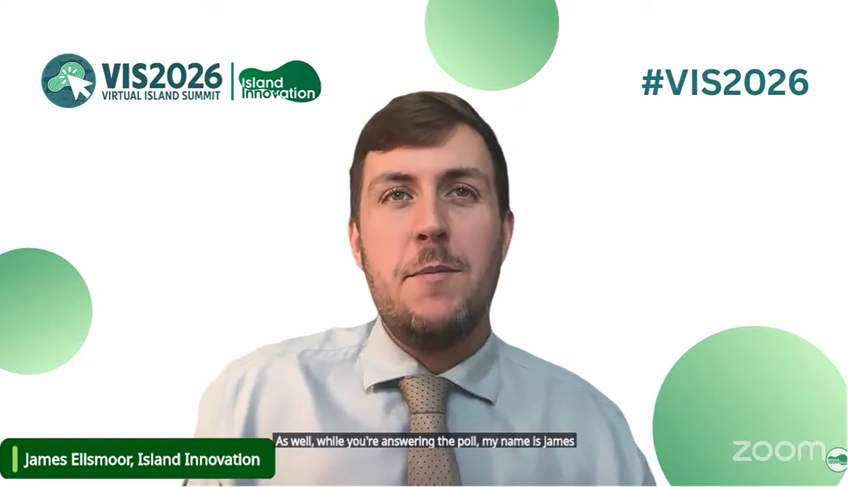
Reflecting on the event, James Ellsmoor, Chief Executive Officer of Island Innovation, said:
“This year’s Summit demonstrated the breadth of expertise that exists across island communities worldwide. It highlighted how islands are not short of knowledge or solutions. What they need is finance and partnerships that reach them, and with pre-COP and COP31 weeks away, that is the gap the world needs to close.”
Since its launch in 2019, the Virtual Island Summit has become the world’s largest free online gathering dedicated to island communities, connecting participants from more than 500 islands and territories through knowledge sharing, collaboration and practical exchange.