









Colombia intercepts boat with 448 kg of cocaine near the Dominican Republic
Source: Colombiaone.com
In the afternoon of Sept. 2, a routine surveillance operation by the FAC over the Caribbean Sea detected a vessel speeding toward Dominican waters. After issuing an alert, cooperation from the Caribbean country’s Armed Forces and the U.S. Joint Interagency Task Force South facilitated the capture of the vessel, piloted by two people, equipped with two outboard motors, and carrying a total of 448 kilos of cocaine.
According to the Colombian Aerospace Force, this action is part of the Zeus strategy and seeks to “disrupt the illicit economies belonging to Transnational Organized Crime (TOC) organizations across the hemisphere through its air power.”
Coordination among the participating forces and the air-maritime technological integration were key to the success of the interdiction, highlighting the decisive role of real-time tracking and operational information sharing in the regional fight against drug trafficking.
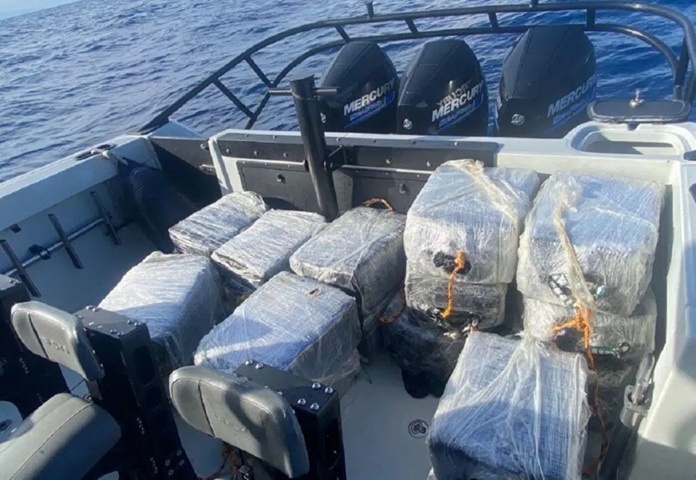
The Colombian Aerospace Force (FAC) neutralized a go-fast-type vessel yesterday that was carrying more than 400 kilograms of cocaine near the Dominican Republic. In the operation, which had the support of the U.S. Joint Interagency Task Force South, two people were captured.
According to a statement from the Colombian Ministry of Defense, the seizure was made possible thanks to FAC surveillance work in the Caribbean Sea, which detected a suspicious vessel and notified Dominican authorities, who provided the exact location so it could be captured after intensive tracking.
That same day, the Colombian police seized a shipment of more than 700 kilos of drugs at the port of Cartagena, which was bound for Spain. These operations come after Colombian President Gustavo Petro condemned the U.S. attack that yesterday destroyed a vessel allegedly carrying drugs from Venezuela to the United States.
Another 743 kg of drugs seized in Cartagena
In addition to the maritime operation, the director of the Colombian police, Carlos Fernando Triana, reported that yesterday authorities also seized a total of 743 kilos of cocaine belonging to the Gulf Clan at the port of Cartagena. Triana explained that the shipment was hidden in a container carrying coal and was bound for Spain, from where it would be distributed throughout the rest of Europe.
“In Cartagena, as part of the offensive against organized crime and criminal activity, we seized the shipment of the alkaloid concealed in a coal container destined for Valencia (Spain).”
The operation “prevented the commercialization of 1.8 million doses, valued at more than 40 million euros (approximately US$46.6 million),” stated the head of the Colombian police.
For his part, the director of the Anti-Narcotics Directorate, Colonel Luis Fernando Serna, highlighted the impact of this result in the ongoing battle against international criminal networks.
“The Anti-Narcotics Directorate reaffirms its commitment to national and international security, working continuously to combat organized crime at all levels, achieving so far this year the seizure of 331 tons of cocaine hydrochloride,” he said.
Colombia’s Petro condemns US attack on drug boat that left 11 dead
All of this took place on the same day that the U.S. neutralized a vessel that, according to President Donald Trump himself, was transporting drugs from Venezuela to the United States through the Caribbean.
The U.S. military deployment in the southern Caribbean, near Venezuelan waters, was justified by The White House as part of its strategy in the fight against drug trafficking, targeting the cartels that ship cocaine from Venezuelan territory. In fact, the U.S. government directly accuses Nicolas Maduro and senior members of his administration of running the so-called Cartel de los Soles and allowing drug trafficking.
Si esto es verdad, es un asesinato en cualquier parte del mundo.
Llevamos décadas capturando civiles que transportan drogas sin matarlos. Los que transportan drogas no son los grandes narcos, sino los jóvenes muy pobres del Caribe y el Pacífico pic.twitter.com/Z55UEMIpsD
— Gustavo Petro (@petrogustavo) September 3, 2025
Although Maduro denied such accusations, claiming that the deployment of U.S. warships represents a threat of invasion of Venezuelan soil, several nations support President Trump’s strategy, while others, as often happens, label the U.S. military presence near Venezuela as “interference” and a “threat to sovereignty.”
Among the critics is Colombian President Gustavo Petro, who yesterday condemned the U.S. action against the vessel, calling it “murder.”
“If this is true, it is murder anywhere in the world. For decades we have captured civilians transporting drugs without killing them. Those who transport drugs are not the major traffickers, but very poor young people from the Caribbean and the Pacific,” wrote the Colombian president on his social media.