



















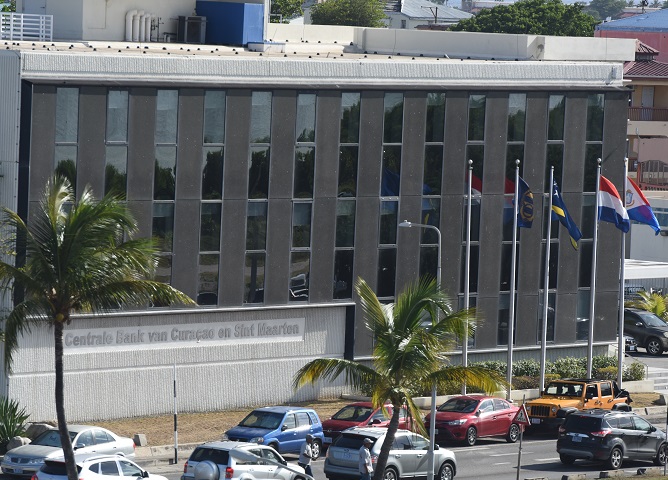



Willemstad/Philipsburg – On June 18, 2026, the Centrale Bank van Curaçao en Sint Maarten (CBCS) decided to maintain its monetary policy stance unchanged. This decision reflects two considerations. On the one hand, the monetary union continues to benefit from a strong external position, with gross official reserves providing import coverage of more than five months. On the other hand, the ongoing uncertainty surrounding developments in the Middle East and their potential spillover effects on commodity and financial markets, as well as resulting implications for the monetary union warrant a cautious approach. Given these divergent developments, the decision is to remain consistent with the U.S. Federal Reserve’s (Fed) June decision to maintain the target range for the federal funds rate unchanged. In the current environment, the CBCS will continue to closely monitor domestic and international developments and will adjust its monetary policy stance if necessary.
Despite a more challenging global landscape and increased market volatility, gross official reserves have continued to increase strongly in 2026. Following a rise of Cg 402.4 million in 2025, gross official reserves further increased by Cg 485.0 million through June 1st, 2026. As a result, the import coverage has remained comfortably above the benchmark of three months, reaching 5.5 months by the end of May 2026. The external position is expected to remain solid throughout the remainder of the year, with the import coverage projected at 5.3 months at year-end and gross official reserves expected to increase by Cg 302.2 million over the course of 2026.
Notwithstanding the monetary union’s solid external position, the outlook remains subject to substantial risks, particularly on the external front. The conflict in the Middle East continues to pose risks to global supply chains and trade routes, leading not only to higher energy prices but potentially also to increased insurance premia and freight costs. Although the recently announced framework agreement between the United States and Iran may reduce these risks and result in lower-than-anticipated average oil prices, the situation remains fragile and uncertain. In an environment of elevated geopolitical risks, international oil prices could remain high for an extended period, increasing the monetary union’s import bill and exerting pressure on gross official reserves through higher foreign exchange outflows.
In addition to developments in the Middle East, ongoing geopolitical tensions, including the war in Ukraine, continue to contribute to global uncertainty. Furthermore, uncertainty surrounding global trade policies, with ongoing tariff disputes and legal challenges, reduce predictability and weigh on investment and economic activity. At the same time, renewed inflationary pressures stemming from higher commodity prices could prolong the period of restrictive monetary policy in the United States, with potential repercussions for global financial conditions and economic growth.
These risks warrant a cautious monetary policy stance and support maintaining the monetary policy stance of the CBCS in line with that of the Fed, given the peg of the Caribbean guilder to the U.S. dollar. On June 17, 2026, the Fed left its target range for the federal funds rate unchanged at 3.50% to 3.75%, citing persistent inflationary pressures and heightened uncertainty surrounding the economic outlook. Against this backdrop, the CBCS decided to keep its pledging rate unchanged at 4.25%, thereby maintaining a spread of 50 basis points above the federal funds rate.
Finally, the CBCS maintained the reserve requirement percentage at 18.50%, given the persistent excess liquidity in the banking system. It will also continue to offer attractive rates on its weekly auctions of certificates of deposit (CDs) to encourage banks to retain excess liquidity domestically, thereby safeguarding the monetary union’s foreign exchange position. These policy decisions are
supported by the monetary union’s solid foreign exchange position and reflect a prudent, forward looking approach in an uncertain global environment.