











New judges sworn in on Sint Maarten as Joint Court president highlights food, self-reliance and a shortage of legal professionals
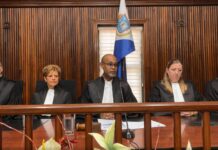
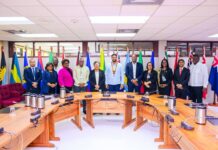
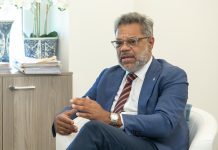
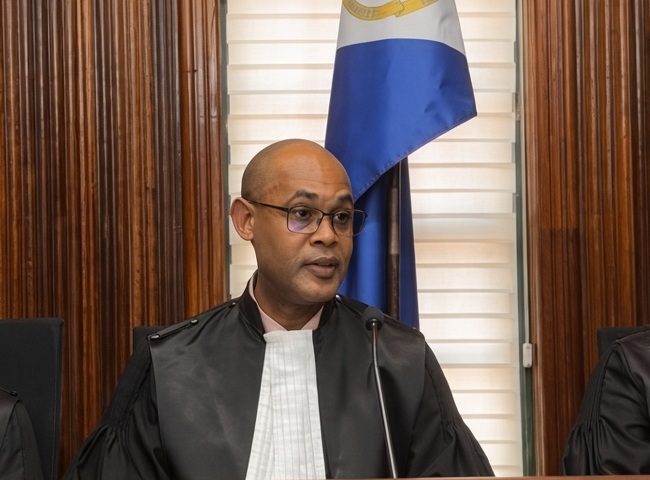
SINT MAARTEN — The Joint Court of Justice (Gemeenschappelijk Hof van Justitie) held an installation sitting in Sint Maarten at which President Sigmar Carmelia welcomed three new judges: Isabelle Severeijns, Jacqueline Broek and Guido Konings. It was Carmelia’s first installation session as president.
His own installation is scheduled for 16 October in Curaçao.
Addressing colleagues, the court’s management board, lawyers, bailiffs, notaries, the press and guests — especially the families and friends of the new judges Carmelia introduced the three appointees and then turned to a theme he said he wished to continue from his predecessor: a social issue tightly bound to the law. This time, the subject was Food.
The new judges
Isabelle Severeijns completed her judicial training in 1998 at the District Court of Arnhem. She later served as judge and senior judge at the District Court of Central Netherlands in family and criminal law, and as press judge, member of the recusal chamber and national training adviser for trainee judges.
In 2018 she became a justice in criminal cases at the Court of Appeal of Arnhem-Leeuwarden, where she also served as press justice and coordinated peer review and internal courses. She has taught as a guest lecturer at the University of Amsterdam.
Former colleagues describe her as a driven judge and investigating judge, an accessible colleague and an excellent lawyer who delegates well and gives others room to work independently. In Sint Maarten she will work mainly as a criminal judge. Carmelia noted her reputation as a good cook and a car enthusiast.
Jacqueline Broek began in the notarial profession after studying in Utrecht and worked as a candidate civil-law notary in Amsterdam until 2017. She then trained as a judge in public, administrative and civil law and served as an administrative judge and interim-relief judge in Amsterdam, including cases on immigration detention.
For the past year and a half she worked at the District Court of North Holland in family and youth cases. Colleagues call her enthusiastic, motivated, collegial, careful and initiative-taking, with international experience that helps her adapt quickly. In Sint Maarten she will sit as a first-instance judge in family law and other areas.
Guido Konings studied law in Nijmegen and practised as a lawyer before becoming a judge in 2022. He worked as a subdistrict judge and investigating judge at the District Court of Central Netherlands and specialised in insolvency law. He also gained experience in banking disciplinary law, taught insolvency procedure and sat on a recusal chamber.
Colleagues describe him as energetic, enthusiastic, accessible, quick to learn and clear in argument. In Sint Maarten he will mainly handle labour cases, summary proceedings and bankruptcies. Carmelia, who also studied in Nijmegen, welcomed him in Spanish: “Bienvenido a San Martín y a nuestra Corte Común de Justicia.”
Carmelia congratulated all three and wished them success and job satisfaction “on The Friendly Island.”
Food for thought
Carmelia said the new judges will confront not only the law but social questions bound up with it. After recent sittings that focused on education and well-being, he chose food.
Everyone needs food and drink every day, he said. Adequate nutrition is a basic right under the Universal Declaration of Human Rights. Yet hunger and food shortage remain a daily reality for too many people worldwide — and in the Kingdom of the Netherlands, in both the Caribbean and European parts. Too many children still go to school hungry.
That right, he argued, is a shared responsibility: government through law and policy; businesses that grow, supply and sell food; schools and hospitals that support healthy living; and communities themselves. The six Caribbean parts of the Kingdom — Sint Maarten, Sint Eustatius, Saba, Aruba, Bonaire and Curaçao — all have a role.
The islands share a dilemma: tropical conditions make self-sufficiency hard, so most food is imported. That makes healthy food expensive and scarce and leaves societies vulnerable, as the COVID pandemic and current geopolitical strain on trade have shown. No government or court ruling can fix this alone, Carmelia said, even though sufficient good food is a basic right.
Differences among the islands can help. Crops that fail on the Leeward Islands may thrive on the Windward Islands, and vice versa. Better use of local soil and climate can serve each island and strengthen the Kingdom. Small steps matter too: a banana tree in a garden, or — in Carmelia’s own case — raising chicks for eggs and meat and sharing the result.
Feeding the law as well
He linked that idea to the court itself. In law, the Joint Court guarantees the legal self-sufficiency of the Caribbean part of the Kingdom and binds societies that chose autonomy to those with a closer tie to the European Netherlands. “Despite those differences we are one,” he said. “We’re in this together.”
That legal community also needs nourishment: enough well-trained talent. Vacancies at the court are hard to fill, including in Sint Maarten. A tight labour market is already felt in hearings — for example when Sint Maarten’s government cannot field enough tax advisers, so the government’s input “dries up” and the law is “insufficiently fed.”
Closing the shortage, he said, requires cooperation among the Joint Court, courts in the Netherlands, the countries’ governments, universities and everyone involved in the administration of justice. That is why he welcomed Severeijns, Broek and Konings: they bring new experience, inspiration and energy to the judiciary in Sint Maarten and, through it, to society.
On behalf of the court, he wished them success and wisdom.