






















New Sint Maarten Judge: A Safer Island Needs Opportunity, Not Only Punishment
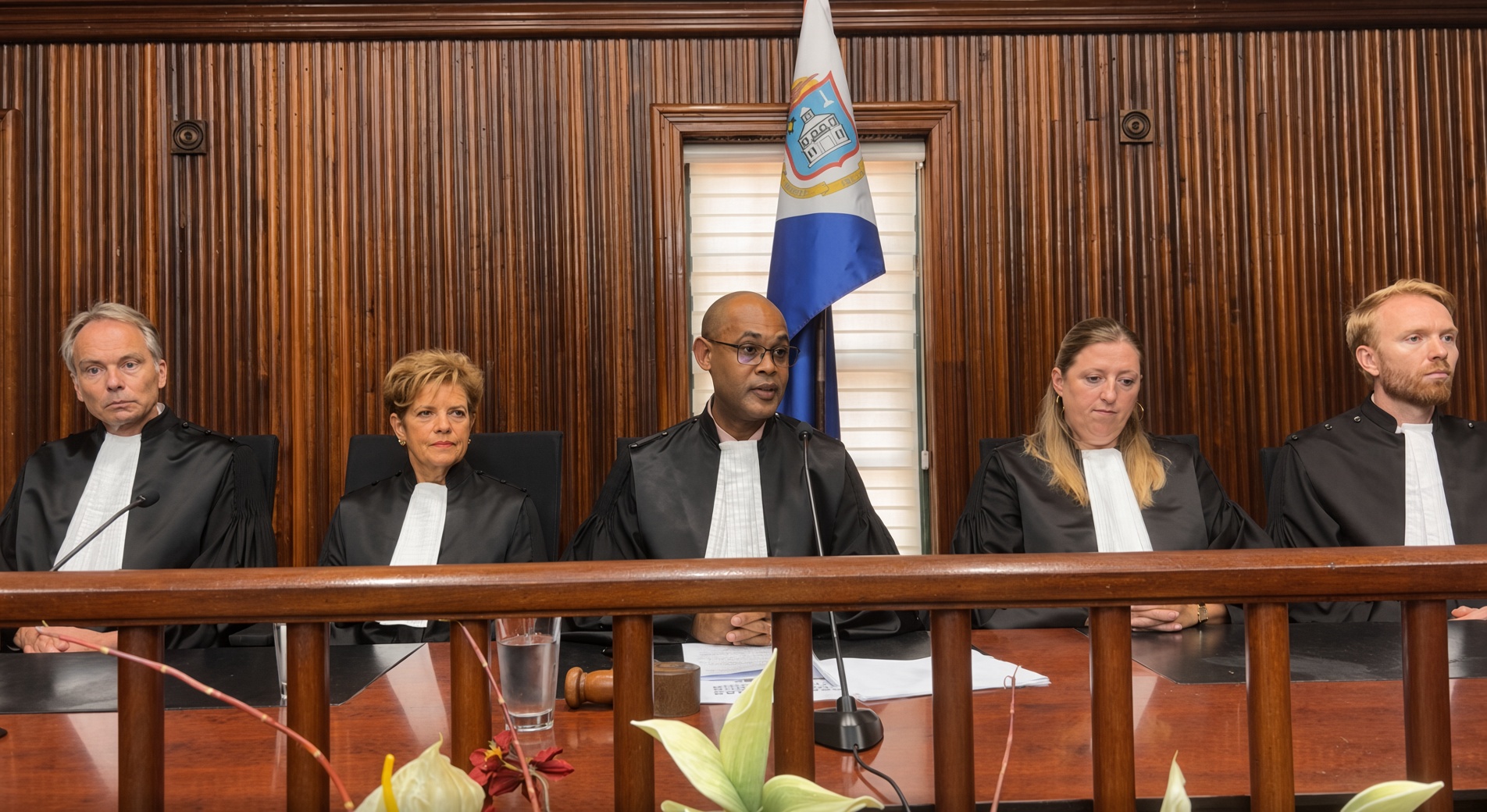
PHILIPSBURG — Judge Isabelle Severeijns, speaking at her installation on Sint Maarten together with colleagues Jacqueline Broek and Guido Konings, called the occasion both a professional milestone and a personal gift: the chance to live and work on an island she said she could never have imagined.
The honor, she said, is more than climate, beaches, and sea views. It is more than a hummingbird at breakfast, turtle tracks on the sand, or a pelican diving for fish and landing on a rock in the surf. It is the people, some whose families have lived here for generations, others who arrived only recently, like the judges themselves, “as strangers, but with a purpose: to contribute to this remarkable island.”
Emigration, she said, is a search for home. “If you emigrate, as we have done, you want the place you go to become your home. But that does not happen without a struggle. ” She joked that Broek may already belong. As a children’s judge, Broek once received a child in a room with a portrait of King Willem-Alexander and Queen Máxima. The girl kept looking at the photo and, at the end of the conversation, asked: “Is that you the lady in the picture? ” Severeijns added that she is less sure about Konings, though “with the beard he comes close, and at least he has the name.
”Broek and Konings arrived with young families: new schools, new friends, a new language. Partners, Severeijns noted, often carry the practical load of moving school runs, groceries, laundry, paperwork. “In that respect, it is better to be the judge.” Her own partner loves the island but still works in the Netherlands. “So I do my own laundry. But I am also a judge.
”She is the only criminal judge in Sint Maarten, and also for Saba and St. Eustatius. Large cases and small ones come to her. That introduction to the island, she said, is “doubly special”: criminal work shows a side of society that is less beautiful than one would wish. Offenses can be serious. So can the social consequences in a small community where, put simply, everyone knows everyone.
A crime and a sentence often has a wide social impact.
The work is therefore especially delicate.The contradiction she faces is this: young men, often between about 20 and 35, sometimes suspected of very serious crimes and facing heavy sentences, can still come across as pleasant, friendly, and sympathetic in conversation. She asks herself what brought them there and, above all, what can be done so they do not sit there again, so they get their lives in order and can take part in Sint Maarten’s small society.“A society does not become safer because we convict people,” she said.
“A society becomes safer when young people get perspective, when they get chances. When they realize they have something to lose by their behavior.”
Justice plays only a limited role. On a small island, people largely have to solve life together. Young people who still have a way forward also deserve “a home that gives them confidence and teaches them to trust themselves.”
Lady Justice, she added, is not easily boxed in. One idea: involve eligible young men in solving small, visible problems. Drivers, she said, are regularly surprised by a sudden “launch” of the car after missing a speed bump, or by a death-defying swerve around a motorcyclist in the middle of the road or by trying to keep tires alive in the holes in the asphalt.“So let us put the young people who deserve a rap on the knuckles to work, and as a sentence have them fill those holes. Let us give them a brush and a pot of yellow paint and have them mark the speed bumps.
On one condition: that next to every filled hole and marked bump a sign is placed: ‘Made possible by the Courthouse!’” Like the hummingbird and the pelican both birds, otherwise completely different, the law admits no standard approach. It is always tailor-made. What fits Sint Maarten does not always fit Saba or Statia, where the communities are even smaller. After a long, intense sitting day on Saba, she and the clerk flew home in a small propeller plane. Seeing Sint Maarten glittering in the sea, she realized more sharply than before that the courts have an important place here.
“If I want to have a good eye for this society, I must integrate, and make sure this truly becomes my home.”At passport control a long line waited. With her recently obtained island identity card she turned right, toward the sign “Residents.”
Pride: “Yes! I am a resident. My house is here.” She also knew it had only been so for a short time, and that others might not yet see her that way. Then came the welcome she said she could have wished for.
The official smiled broadly and said: “Welcome home, dear!”