
















Voices over Violence: prosecutor urges courts to look for talent where they once saw only problems
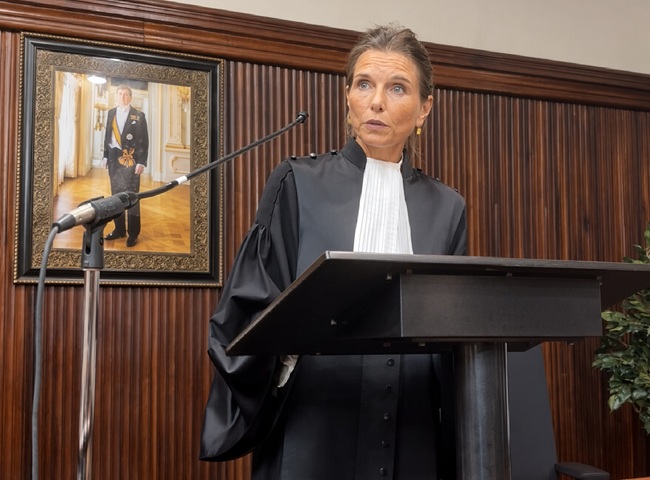
PHILIPSBURG — Three new judges were installed at the Court of First Instance in Sint Maarten on Monday, as Chief Prosecutor Manon Ridderbeks used the ceremony to congratulate the newcomers and to issue a broader challenge to the justice system: stop waiting until young people appear in a case file before truly seeing who they are.
The Honorable Isabelle Severeijns, Jacqueline Broek and Guido Konings crossed from the Netherlands to take up posts on the island. Ridderbeks, speaking in her capacity as Attorney General, congratulated them and their families for “a leap of faith” into a new country, a new workplace and “a new life.
”She also congratulated the Joint Court of Justice and the Court of First Instance, saying the bench would be strengthened by three experienced judges with different backgrounds.
Severeijns, described as the nestor of the trio, has been a judge for almost 30 years, with family law and criminal law as the common thread in her career. Konings practised for years as a lawyer in insolvency and corporate law before joining the judiciary and, Ridderbeks said, “understands the language of attorneys.” Broek began as a working student in family and juvenile law, later worked as a candidate civil-law notary, and has now returned to Sint Maarten to the field where her career started.
The ceremony, Ridderbeks said, was first of all a moment of celebration. Independence, impartiality and integrity remain the core values of an institution “of fundamental importance to our society.”
Recruitment remains a strain
She then turned to a problem felt across the courts, the Public Prosecution Service and government more widely: finding people willing to commit to Sint Maarten for the longer term.
Young people from the island often leave to study abroad, earn degrees and gain experience. Many do not come back. Salary, housing and career prospects play a part, she said. So does the nature of a small society.
“Someone who grew up here and returns after several years with a degree soon discovers that completing an education does not automatically mean that society makes room for you,” Ridderbeks said. People see not only qualifications but family history.
Ambition can be read as arrogance; success can meet scepticism rather than appreciation. Young professionals may feel they have to prove themselves twice.
Institutions, she added, are “all fishing in the same small pond.” That raises a sharper question: whether recruiters look too narrowly at people who already fit a pre-designed profile.
A different look at young people
Ridderbeks pointed to another group well known to the Court of Guardianship, probation, police, the legal profession, prosecutors and the courts: young people encountered in the course of official duties.
“To them, we do not necessarily represent the rule of law. To them, we are often the enemy.”
She was not, she stressed, proposing that application forms be handed out after every remand hearing. Behind the provocation lay a serious question: when someone stands before the court, do officials see only a name, a case number and a list of convictions — or a young person with talents that no one has ever really called upon?
The Public Prosecution Service will still prosecute serious crime, protect victims and uphold the rule of law, she said. But it cannot be the ambition of the system “to first get to know our young people when their name appears at the top of a criminal case file.”
Voices over Violence
That concern, she said, connects to Voices over Violence, a project in which the Public Prosecution Service is actively involved. Grown out of a Field Lab approach, it brings multiple stakeholders together around gun violence among young people and looks at the problem from a different angle.
Nine young people close to the issue are being recruited as consultants. They are expected to reflect on causes and work with institutions on solutions. Based on their recommendations, and with support from the Ministry of Justice, a Youth Empowerment Hub is planned: a safe place for mentorship, skills training and positive opportunities.
“To offer perspective. To develop talent. To discover possibilities. To become part of the solution rather than part of the problem.” Perhaps, Ridderbeks said, the person who understands why a sixteen-year-old carries a firearm is not someone who studied law or criminology — but that sixteen-year-old himself. Reducing gun violence requires that knowledge. It also requires institutions to ask a different question when they hire: who are we overlooking?
Not every participant will end up working for police, the courts or government. Progress would already be made, she said, if some of them discovered that institutions they believed stood against them also belong to them — and that the rule of law belongs to everyone.
A charge to the new bench
Returning to the new judges, Ridderbeks said they will meet people at exceptionally difficult moments: those who have done something terrible, those wrongly accused, and those whose poor choices have had consequences far greater than they foresaw.
Their task is to assess conduct thoroughly and with an open mind, while holding two thoughts at once: people who are accountable are responsible for what they do, and a person is always more than what he or she did on the worst day of his or her life.
The same logic applies to prosecutors. Success cannot be measured only by the number of cases brought to court. The rule of law also grows stronger when fewer young people have to appear there at all.
That, she said, is the deeper meaning of Voices over Violence: not to be softer on violence, but smarter about preventing it; not to lower standards, but to give more people the chance to meet them.
She wished the new judges wisdom, independence and impartiality — and curiosity: the determination to keep seeing the human being behind every case file.
“To see more than the case before us, to hear more than the voices we already know, and to make sure that voices become stronger than violence.”