


















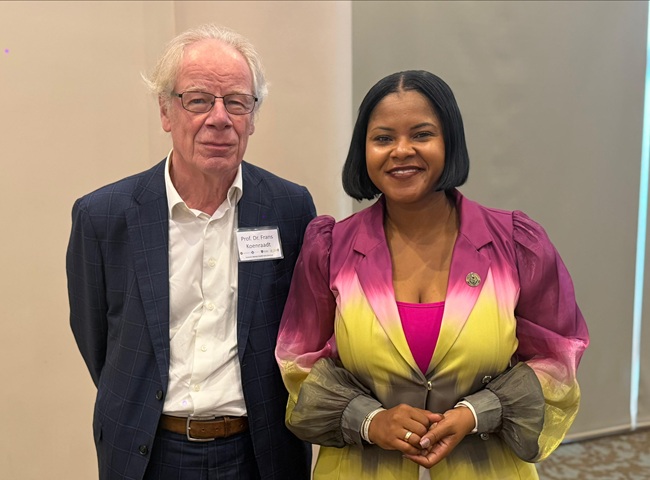



Philipsburg / Aruba — Member of Parliament Sjamira D. M. Roseburg, speaking in her capacity as a criminal defense lawyer, recently delivered presentations during the “Psychiatric and Psychological Assessments and Reports: Entrance to Forensic Care in the Caribbean V Conference.”
The conference brought together Kingdom partners and professionals from across the Caribbean and the Kingdom of the Netherlands, including judges, prosecutors, lawyers, psychologists, psychiatrists, and other experts working in justice and mental health.
Speaking from the perspective of a lawyer who has practiced criminal law for over ten years, Roseburg focused on the practical reality she encounters in courtrooms when psychiatric and psychological reports are used in criminal cases.
She explained that these reports are extremely important because they help courts understand not just what someone did, but why it happened. Judges rely on these assessments to determine whether someone was suffering from a mental disorder at the time of a crime, whether that condition influenced their actions, and whether treatment may be necessary in addition to or instead of prison.
However, Roseburg stressed that while the system works well on paper, the reality in the Caribbean often looks very different.
One of the biggest challenges is the facilities such as mental health foundation and turning point being full. Next to that the limited number of specialists available to conduct these forensic evaluations. In larger countries, teams of psychologists and psychiatrists may spend weeks or months observing and evaluating someone. On small islands, the same type of assessment sometimes has to be done with far fewer resources and not by a specialist in that specific field. Or the specialist needs to come from other parts within the kingdom. This can delay the court proceedings for months.
Another issue raised during her presentation was fairness within the justice system. In theory, a defendant has the right to request a second expert opinion if they disagree with a report. In practice, however, defendants often have to pay for this second evaluation themselves, which means not everyone can afford to challenge the findings.
Roseburg also spoke about the challenges that arise even after a judge makes a decision.
In some cases, courts determine that someone needs specialized treatment rather than only imprisonment. Yet because the necessary facilities or programs are limited, individuals may remain in detention simply because there is nowhere else for them to go.
She shared examples from her legal practice to illustrate these difficulties.
In one case, a court ruled that an individual suffering from serious mental health problems needed to be transferred to a specialized treatment facility. However, because of delays within the Kingdom system, that transfer took years to complete, leaving the person detained in conditions that were not designed for long-term mental health care.
In another situation, someone in Aruba received a sentence that included both prison time and a treatment measure (TBS) Yet because the required treatment facilities were not immediately available, the system struggled to implement the court’s decision in practice.
“These types of situations show that the justice system does not only need good laws,” Roseburg explained. “It also needs the resources and institutions to actually carry out those decisions.”
She also highlighted the importance of aftercare once someone leaves prison. Without proper support, supervision, and guidance, the chances of someone committing another offense increase significantly. Investing in aftercare, she noted, ultimately leads to safer communities and fewer repeat crimes.
Roseburg further referenced Article 43 of the Charter for the Kingdom of the Netherlands, which states that countries within the Kingdom are responsible for safeguarding human rights and legal certainty, while the Kingdom itself has a role in ensuring those rights are protected when structural issues arise. We cannot continue to fail our people. It’s a kingdom responsibility!
Looking ahead, she pointed out that there is hope. Seeing ongoing justice reforms by the ministry of justice and the planned new prison facility in Sint Maarten as an opportunity to improve the system. She emphasized that modern facilities should focus not only on security, but also on diagnosis, treatment, and rehabilitation and prevention’
“The justice system should not only focus on punishment,” Roseburg said. “It should also focus on understanding people, addressing the root of problems, and creating safer societies for everyone.”
The conference served as an important opportunity for legal and mental health professionals across the Kingdom to exchange knowledge and discuss how forensic care systems in the Caribbean can continue to improve.