


















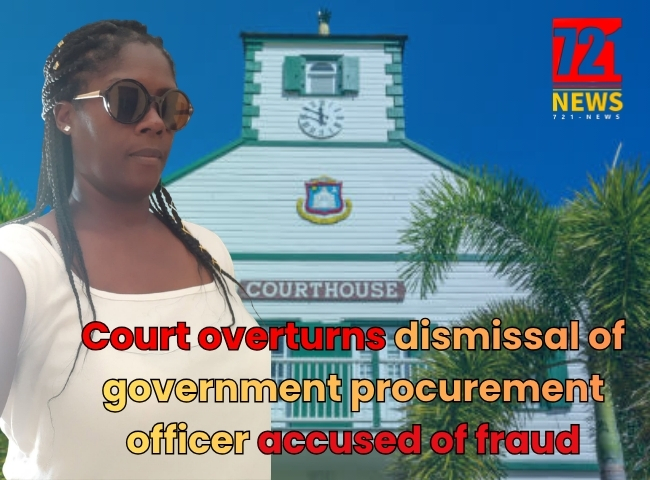



PHILIPSBURG — The Court in Civil Servants Cases has overturned the dismissal of a senior government procurement officer who was accused of defrauding the Government of St. Maarten, ruling that authorities failed to prove the allegations and relied on an incomplete investigation.
Althea Richardson, who worked for government since 1997 and served as Head Officer for Procurement and Management within the Department of Facilities Affairs, was fired in August 2025 following an investigation into alleged irregularities in purchasing and budget management within the Ministry of General Affairs.
Government accused Richardson of manipulating procurement procedures, steering contracts to preferred suppliers, facilitating inflated invoices and signing for goods that allegedly were never delivered. Investigators also claimed she advised suppliers which company names to use and forwarded competing quotations to favored businesses.
The court, however, found that the allegations of fraud and abuse of office lacked a sufficient factual basis.
In one of the ruling’s strongest passages, the court noted that the forensic report repeatedly used terms such as “possibly”, “likely”, “appears to indicate” and “could have”, but failed to establish concrete facts proving fraudulent conduct. “Such far-reaching accusations require a sound factual basis,” the court stated.
Judges further ruled that merely being involved in a chaotic procurement process, communicating with suppliers or signing documents did not amount to proof of fraud.
The case exposed what the court described as serious structural weaknesses within government’s procurement system.
According to findings cited by the court, there were no clear procedures governing orders, supplier selection, price comparisons or approval authority within the department. Responsibilities between Richardson and her supervisors were never clearly defined.
The court noted that it remained unclear who selected suppliers, who awarded contracts and who made final purchasing decisions. Richardson consistently maintained that she acted under instructions from her supervisor and lacked authority to approve purchases or payments herself. Government failed to adequately refute those claims, according to the ruling.
The judges also criticized the handling of the forensic investigation conducted by Forensic Caribbean. Although Richardson submitted responses and objections to the draft report, the court found no evidence that a final report was ever produced or that her comments were taken into account before the dismissal decision was made.
While the court acknowledged that some purchases appeared to involve unusually high prices, it found insufficient evidence linking Richardson personally to the decisions or proving that she violated her duties as a civil servant.
Similarly, allegations that she signed for undelivered goods could not be substantiated because government failed to prove that the goods had not been delivered or that Richardson knew they had not been received.
The court concluded that while there may have been irregularities within the procurement process, these could not automatically be attributed to Richardson alone.
As a result, the court declared her objection well-founded, annulled the dismissal and ordered government to restore her legal employment status. Government was also ordered to pay Cg. 1,400 in legal costs.