

















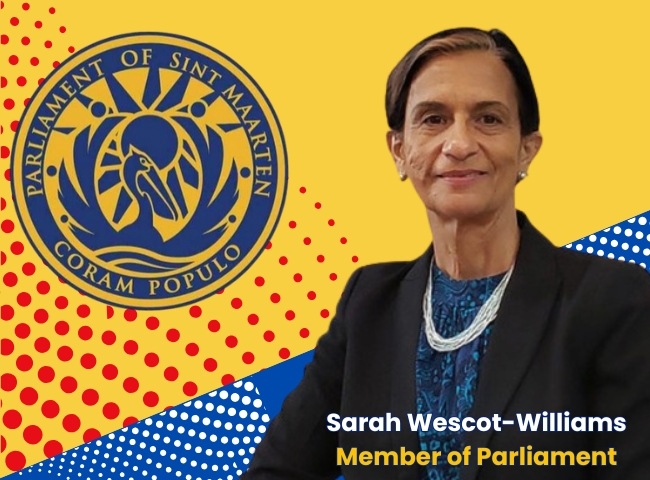



President of Parliament Sarah A. Wescot-Williams says the unprecedented use of artificial intelligence during Parliament’s review of the 2026 national budget should be seen as an important learning moment for the institution and an opportunity to strengthen parliamentary oversight.
Reflecting on the submission of thousands of budget questions by Members of Parliament, the President noted that the experience demonstrates both the tremendous potential and the practical challenges of integrating artificial intelligence into parliamentary work.
“The volume of questions has generated considerable public discussion,” Wescot-Williams said. “Some have applauded the thoroughness of Parliament’s oversight, while others have questioned whether such a volume is practical or even effective. I believe both perspectives deserve consideration.”
She explained that, for the first time, many Members used artificial intelligence to assist in reviewing the national budget.
“Artificial intelligence has democratized access to knowledge,” she stated. “It enables every Member -regardless of the size of their staff or available resources- to analyze complex budget documents, identify inconsistencies and generate questions in a fraction of the time previously required. That is a significant advancement for parliamentary democracy.”
However, the President cautioned that new technology also requires new approaches to parliamentary work.
“When every Member independently asks AI to analyze hundreds of pages of budget information, the result is predictable. Hundreds of questions quickly become thousands. Many are valuable. Many overlap. Some ask essentially the same thing in different ways.”
According to Wescot-Williams, this creates an enormous burden on the Government’s administrative machinery and may ultimately undermine Parliament’s objective.
“Our goal should never be to ask the greatest number of questions. Our goal must always be to obtain the best possible information on behalf of the people we represent. If the Government is overwhelmed by volume, there is a real risk that responses become standardized, superficial or repetitive. In that case, Parliament is not necessarily better informed.”
The President believes the experience presents an opportunity for Parliament itself to evolve.
“For some time now, I have advocated for a Parliament that continues to mature as an independent institution. Our constitutional responsibilities extend beyond reacting to the Government. We legislate, we represent and we exercise oversight. But we must also continuously strengthen our own institutional capacity to perform those responsibilities effectively.”
“Imagine Parliament first undertaking a shared institutional review of the budget. Members could collectively identify the major financial risks, policy inconsistencies, implementation concerns and accountability gaps. That process would not replace political debate. It would enrich it.”
Wescot-Williams emphasized that each political faction would remain entirely free to pursue its own priorities, submit additional questions and hold ministers accountable according to its own political convictions.
“Parliamentary independence would remain untouched. What would change is the quality of our preparation. Instead of producing thousands of disconnected questions, we could produce a sharper, more strategic line of inquiry. Success should be measured by the quality of the answers we receive and the decisions that follow.”
The President noted that legislatures around the world are confronting similar challenges as artificial intelligence reshapes public institutions.
“AI has changed the equation. The ability to generate information is no longer the scarce resource. AI can produce information in seconds. The scarce resource is judgment. knowing which questions matter most, recognizing patterns, connecting risks across ministries, evaluating policy choices and exercising sound parliamentary judgment. That remains the responsibility of elected representatives.”
“The initiative also aligns closely with my broader vision of an Open Parliament.”
“Too often, openness is understood simply as publishing documents or livestreaming meetings. Those are important, but they are only the beginning. A truly Open Parliament is one that promotes understanding, encourages participation, strengthens collaboration and continuously improves the way it serves the people.”
She envisions a Parliament where Members are better prepared before debates begin, committee work is more analytical, information is more accessible to citizens, and technology enables legislators to spend less time processing information and more time exercising sound judgment.
The President concluded by expressing confidence that Sint Maarten has an opportunity to demonstrate leadership in parliamentary innovation.
“Small jurisdictions are often told to follow others. I believe Sint Maarten can also innovate. We can demonstrate that a small Parliament, equipped with modern tools and guided by a clear vision, can become more independent, more transparent, more collaborative and ultimately more effective in serving the people of Sint Maarten.”
BY MP SARAH WESCOT-WILLIAMS,
PRESIDENT OF PARLIAMENT.