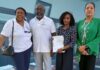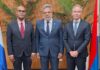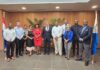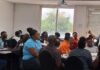


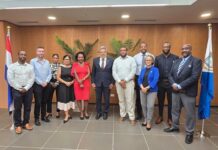
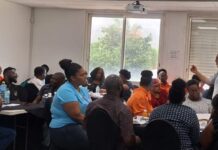





Philipsburg, Sint Maarten — The Division of Educational Innovation of the Ministry of Education, Culture, Youth and Sport hosted a three-day STEM to STEAM Teacher Training Workshop, aimed at strengthening innovative, interdisciplinary, and student-centered teaching practices within Sint Maarten’s schools.
Participants included educators from public and government-subsidized Preparatory Secondary Vocational Education (PSVE) schools.
The professional development workshop, facilitated by Dr. Delroy Pierre, focused on supporting educators to transition from STEM, Science, Technology, Engineering and Mathematics to STEAM, which incorporates the Arts as an integral component of creativity, design, communication and problem-solving.
Throughout the three-day training, participating educators explored how STEAM can move beyond the traditional teaching of subjects in isolation by connecting different disciplines around authentic problems, inquiry, and project-based learning. The workshop emphasized creativity, critical thinking, collaboration, Creative Problem Solving (CPS), explicit instruction, process based assessment, and the effective use of rubrics.
One of the highlights of the workshop was a practical popsicle-stick bridge challenge, during which educators were tasked with designing and constructing a bridge using no more than 100 popsicle sticks and glue. Each bridge was required to span 30 centimeters and withstand increasing force. The finished structures were tested using heavy dictionaries, allowing participants to experience firsthand the process of designing, measuring, constructing, testing, evaluating, and improving a solution.
The activity demonstrated how Mathematics, Science, Engineering, Technology, and the Arts can naturally intersect within a single classroom project while simultaneously developing teamwork, communication, perseverance, and creativity. The exercise also reinforced that meaningful STEAM education does not necessarily require expensive equipment; thoughtfully designed activities using simple and accessible materials can stimulate deep learning and problem-solving.
An important component of the training also focused on assessment as a process. Educators were encouraged to evaluate students throughout the different stages of a project, including research, planning, design, construction, testing, presentation, and reflection rather than assessing only the final product. This approach provides teachers with a more complete understanding of student learning while creating opportunities for intervention, feedback, and improvement throughout the learning process. It also allows students to demonstrate progress and achievement at multiple stages rather than having their performance be determined solely by a final product or grade.
The workshop further emphasized the importance of collaboration across subject areas. By breaking down traditional subject silos, educators can work together to develop projects in which students understand how knowledge from different disciplines connects to real-life situations and challenges.
The training forms part of the Division of Educational Innovation’s continued efforts to support educators in strengthening classroom practices and preparing students with the creativity, critical-thinking, communication, collaboration, and problem-solving skills required for the future.
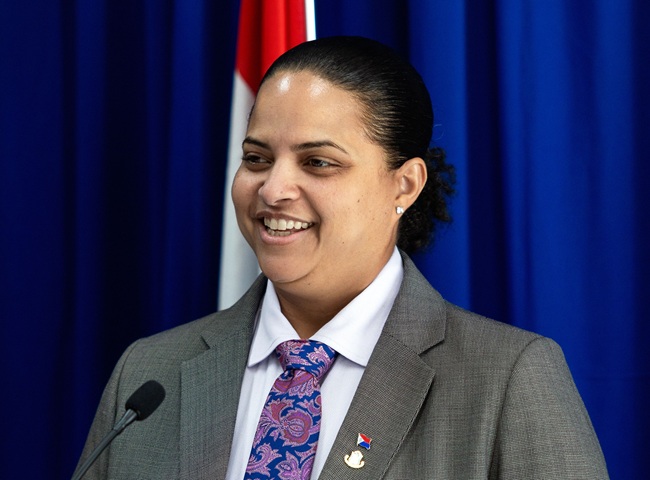
Minister of Education, Culture, Youth and Sport noted that continued investment in teachers must go hand in hand with greater exposure to the technologies that are reshaping education and the world in which students will live and work.
“Professional development must equip our teachers to bring new ideas, technology and innovative approaches into the classroom. As we increase exposure to emerging tools such as artificial intelligence, our focus must remain on empowering teachers to use innovation in ways that inspire our children, strengthen learning and help every student realize their potential.”
Following the successful workshop, attention will now turn toward supporting implementation during the 2026–2027 school year. The workshop identified several areas for continued support, including STEAM professional development for school managers and directors, greater opportunities for interdisciplinary planning, strengthened use of process-based assessment and rubrics, increased use of low-cost hands-on STEAM activities, and follow-up opportunities for participating teachers to share their classroom implementation experiences.
Ultimately, the training reinforced a central principle for the future of STEAM education in Sint Maarten: clear expectations, creative freedom, interdisciplinary collaboration, and process-based assessment can create stronger and more meaningful learning experiences for students.