












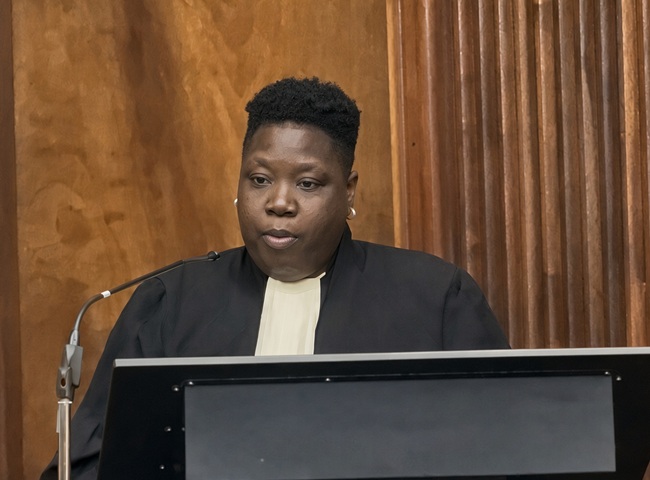
PHILIPSBURG — Sint Maarten’s newest judges were formally installed this week with a pointed message from the Bar: the law cannot be applied as if Philipsburg were Rotterdam. Zylene Bary, Dean of the Sint Maarten Bar Association, told government leaders, members of Parliament and the Joint Court of Justice that the bench must practice “contextual justice” applying the law with a clear view of how people on the island actually live, work and save money.
“You are joining a jurisdiction that is dynamic, demanding, and profoundly unique; or simply put SXM … the best,” Bary said, welcoming the three new judges on behalf of the legal community. An installation, she argued, is not only a celebration.
It is a moment of alignment. The court’s tool is the law; the Bar’s duty is to remind the court that the law exists “to serve the living, breathing people of Sint Maarten. ”Culture, cash and the courtroom Bary praised the court Hof and vestiging SXM, for moving beyond theory and using English in practice: parts of judgments, appeal information and courtroom proceedings.
That change, she said, has lowered a “massive psychological barrier.” Language, however, is only the first layer. The next is how Sint Maarten’s economy works. The island remains, in many ways, a cash-based society. Missing bank statements or formal receipts that might look like evasion in Europe are often “just Tuesday” here. She pointed to the Caribbean savings practice known as partner hand: trusted groups pool cash each week or month and take turns receiving the full pot. Large sums move on trust, with no bank trail.
If such a dispute reaches court, she said, a rigid demand for European-style paperwork would “systematically disenfranchise” the citizens who relied on it. Contextual justice means treating those systems as economic realities, not as fraud or money laundering by default. Proof, she added, can look different on Sint Maarten than in the Netherlands and that matters, because an appeal is often “an unattainable luxury.” Legal aid under strain Bary then turned to the government.
Cultural awareness is not enough if people cannot afford to enter the courthouse. Social legal aid, (gefinancierde rechtsbijstand), known locally through the yellow cards or (bewijs van onvermogen) is under “severe, unsustainable pressure.”
Compensation for pro-deo lawyers has lagged behind the cost of practice, even as Bonaire has recently indexed its rates. The path from intake to an addition is so slow that appeal deadlines can expire before aid is granted. Evictions, wrongful terminations and challenges to ministerial decisions are lost in the paperwork. The result, she said, is a crisis inside the Bar. Several firms no longer accept yellow-card cases. A shrinking pool of lawyers is overloaded with complex files and frequent conflicts of interest, and “the entire judicial wheel grinds to a halt.”
The Bar has set up a committee to map bottlenecks and propose a new tariff system. But Bary was clear: access to justice is a constitutional right, and funding an efficient system is an obligation of Country Sint Maarten. She recalled the Governor’s recent reminder, at the opening of the parliamentary year, that core government functions need further investment. Access to justice, she said, is one of them. “The legal aid grid is not a subsidy for lawyers; it is a shield for the vulnerable.”
When lawyers are priced or locked out, it is the single mother, the fired employee and the overlooked heir who suffer. Unrepresented litigants then clog the courts and wear down the judiciary. A pledge to the new bench Bary asked the new judges to look at the person before them, not only the file; to hear the nuances of local language; and to understand the constraints of the island. The Bar, she said, will challenge the court and advocate fiercely and will also stand with it so the court remains “a reliable venue for accessible, practical, and true justice.”
“Welcome to Sint Maarten. May your judgments be sharp, your hearts empathetic, and your wisdom deeply rooted in the context of our beautiful community.”