












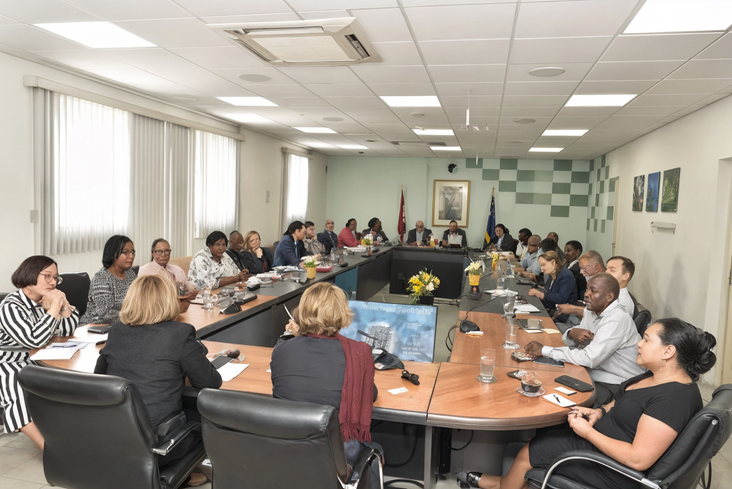
WILLEMSTAD, Curaçao — Curaçao does not so much suffer from a shortage of analysis as from a shortage of implementation capacity. That was the clear undertone on Thursday April 2, at a development roundtable hosted by the Social and Economic Council (SER) of Curaçao, with representatives of the United Nations (U.N.) and other stakeholders. The meeting was intended to test and sharpen the U.N.’s current reading of Curaçao as officials prepare the next cooperation framework for 2027 through 2031. What emerged most clearly was that the island’s biggest challenges are largely understood, but that the translation of diagnosis into coherent policy and concrete action still too often breaks down.
That gave the meeting a different character from an ordinary consultation. The discussion was not simply about which risks and constraints Curaçao faces, but about why progress so often lands unevenly. Across the briefing materials and the discussion, the same themes kept intersecting: income security, the quality of work, education and skills, aging, care, energy security, climate resilience and the government’s capacity to sustain policy in practice. The emphasis shifted, in other words, from describing problems to asking what institutional conditions are needed to make policy executable.
That is not an academic point, according to the advisory council. Curaçao’s social reality shows how limited the meaning of economic growth remains when large parts of the population stay vulnerable. According to figures presented at the meeting, unemployment fell to 7.8 percent in 2024, youth unemployment to 16.3 percent, and employment rose to about 72,000. At the same time, 30.4 percent of households live below the poverty line. That combination — recovery on paper, but persistent insecurity in many households — made clear during the roundtable that Curaçao’s next phase of development is not only about growth. It is about better jobs, steadier incomes, formalization and greater resilience.
Aging also loomed large in the discussion. Curaçao has 156,115 residents, 33.8 percent of them age 60 or older. That reality touches not only health care, but pensions, labor supply, housing and the sustainability of public finances. In that sense, the meeting underscored again that demography is no longer a separate policy file. It is a structural force running through nearly every socioeconomic question on the island.
For the SER, that is precisely where the United Nations can be most useful. Not by adding yet another layer of analysis, but by helping Curaçao set priorities more clearly, connect policy more intelligently and reduce fragmentation in execution. “Curaçao’s task is no longer primarily to describe its problems more sharply, but to align policy, data and implementation more effectively so that reform is felt in people’s daily lives,” the SER said. That is consistent with the purpose of the roundtable, which explicitly examined where the U.N. could make the greatest difference through policy advice, technical support, convening and advocacy.
Thursday’s outcome, then, was not that Curaçao acquired a new list of problems, but that its priorities came into sharper focus. The discussion pointed toward a development agenda in which social protection, labor-market opportunity, data, climate resilience, the energy transition and institutional capacity can no longer be approached in isolation from one another. The meeting’s input will be carried into the further development of the new U.N. framework for 2027-2031. For the SER, the objective is clear: cooperation produces not only analysis but also helps move the island from insight to execution.