
















Subject: The legal requirements for police appointment, the unarmed Tourist Police proposal, the role of the VKS, and the chain of command between police and military in Sint Maarten
Minister Tackling,
I write as a concerned citizen who has reviewed the applicable laws. The course now being taken on tourism security, and on cooperation with military personnel, raises serious legal and operational concerns and risks discrediting the lawful chain of command.
- What the law requires to become a police officer in Sint Maarten
Appointment as a police officer is not an administrative convenience. It is governed by:
- the Rijkswet Politie van Curaçao, van Sint Maarten en van Bonaire, Sint Eustatius en Saba (Kingdom Police Act);
- the Landsverordening Politie (National Police Ordinance of Sint Maarten);
- the Landsbesluit Rechtspositie Korps Politie Sint Maarten (Legal Status Decree);
- the Onderlinge Regeling setting quality requirements, education, and training, including Article 3.1.
Under those instruments, a candidate must, among other things:
- hold Dutch nationality, or legally belong to Sint Maarten;
- be of good moral character, with a clean criminal record and no risk of misuse of weapons;
- meet the minimum educational standard under Articles 12 and 13 of the KPSM Legal Status Decree and the competence-based outcomes agreed by the Netherlands, Curaçao, and Sint Maarten;
- pass extensive screening, including medical, psychological, physical fitness, polygraph, and background investigation.
An aspirant is appointed in temporary service for the duration of basic training (BOPK), at salary scale 4. Article 30 provides that salary is paid monthly. Article 25 requires a written appointment before the officer takes up the position, and in any event within two months of beginning work. Under Article 7 of the Landsverordening Politie, police officers are appointed by landsbesluit, signed by the Governor under Article 40 of the Constitution and by the Minister of Justice.
A person does not become a police officer by putting on a uniform. Appointment by the Country, through the Governor, confers full police powers, including the lawful use of force and firearms under the Wapenverordening and the Ambtsinstructie. That framework makes an unarmed “Tourist Police” difficult to reconcile with the law.
- An unarmed Tourist Police unit is unsafe and poorly conceived
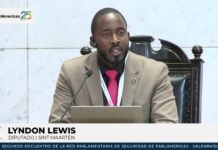
You told Parliament that the proposed tourist police unit is not intended to replace the Sint Maarten Police Force (KPSM), but to serve as a specialized support unit focused on prevention, visitor assistance, and a greater security presence in tourism areas. You further indicated that the unit would not conduct criminal investigations, would not respond to 911 calls, and would not perform duties in which firearms may be required, and that pepper spray and stun guns were under consideration.
Tourists are being robbed at gunpoint by offenders carrying illegal firearms. Jewelry stores, Maho, Simpson Bay, and Front Street are high-risk locations. Sending unarmed personnel in tourist-police shirts into those areas is not prevention. It places those personnel, and the public they are meant to assist, at risk.
Member of Parliament Labega welcomed the pilot, while also calling for a national discussion on modernizing self-defense rules and on greater lawful access to firearms for business owners and security personnel, precisely because KPSM cannot be everywhere. If the need is greater presence in tourism areas, Sint Maarten already has a legal, armed, and trained capacity that is not being used for that purpose.
- The VKS is armed, trained, and sidelined
The Vrijwilligerskorps Sint Maarten (VKS) is established by law. It is not a private security company. Its members are trained by the Royal Dutch Marines in military operations in built-up areas, weapons handling and safety, extended field exercises, road marches, target practice, sea-rescue drills, checkpoints, and radio communication. Under the Vrijstellingsbesluit to the National Ordinance on Arms, the Minister of Justice may exempt VKS officials from the ordinary permit requirement so that they may carry weapons in public. The VKS already cooperates with KPSM and the French Gendarmerie on safety controls.
Yet in homeland-security situations—after Hurricane Irma, during armed robberies, and during border pressure—the VKS is given little or nothing to do. The only volunteer corps trained and legally authorized to handle firearms is sidelined, while an unarmed tourist unit is proposed. The VKS should be given a clear, lawful role in homeland security, or the decision should be taken to disband it. It should not be left idle while unarmed personnel are placed in harm’s way.
- Police do not command Marines
The most serious issue is the chain of command.
Under Kingdom law, the Royal Netherlands Navy, the Netherlands Marine Corps, and the Royal Marechaussee fall under the Ministry of Defence. Article 97 of the Constitution of the Netherlands provides that the Government has supreme authority over the armed forces. The Marechaussee maintains a permanent Caribbean presence. Its Caribbean brigade provides police services to Dutch military personnel, to the personnel of the Aruba and Curaçao militias, and at military locations, and it supports the local police. Support runs in that direction, not the reverse.
Marines on Aruba (32 Raiding Squadron / Marine Squadron Caribbean) fall operationally under the Naval Commander of the Caribbean (CZMCARIB). Marines deployed to Sint Maarten after Hurricane Irma in 2017 provided medical assistance and helped maintain order under their own military command. The Kingdom Police Act rests on the Charter and the Constitution: the police act under national authority; the military act under Kingdom authority.
On that basis, a Chief of Police has no power to question or command a Marine. A Marine is a military serviceman under military law and under the command of his Marine commander, not under a civilian police chief. Arrangements in which military personnel take orders from police officers who have no legal jurisdiction to give them discredit the chain of command and are, in my view, unlawful.
Where KPSM and Marines work together, the proper division is straightforward:
- for police tasks, the Marechaussee supports KPSM;
- for military tasks and defense, KPSM supports the military;
- In joint public-order operations during disasters, Marines operate under CZMCARIB and their own commander, in coordination with the Governor and the Minister of Justice, not under direct orders from the Chief of Police.
That relationship has been inverted. When military assistance is deployed, Marines are not subordinate to the police. This should be corrected by the Kingdom Government and the Kingdom Prosecutor. The Attorney General’s supervisory role under Article 8 of the National Decree on the National Detectives is also relevant.
What I ask
- Publish the full legal basis—landsverordening, landsbesluit, and function book—for the Tourist Police. If these personnel are Extraordinary Agents of Police under Article 10 of the Kingdom Act, they must meet the same requirements as police officers.
- Abandon the unarmed Tourist Police concept. If a tourism unit is required, arm and train its members at the Police Academy on the same basis as other officers, or assign the task to the VKS, which is already armed and trained.
- Give the VKS a formal legal role in homeland security by national decree, with funding and defined tasks.
- Have the Kingdom Government and the Kingdom Prosecutor restore the chain of command: no police officer, including the Chief of Police, has legal authority to command Marines. Joint operations involving military deployment must remain under military command, consistent with Article 97 of the Constitution and the relevant Kingdom legislation.
- Request the Law Enforcement Council to examine this departure from the lawful chain of command.
No person is above the law—not the Minister of Justice, and not the Chief of Police.
Rene “Koto” Wilson
Concerned Citizen
Source: Koto Wilson Facebook page