

















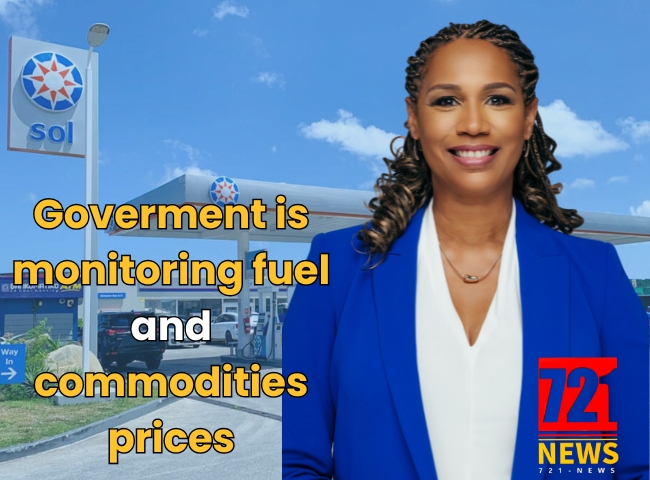



POND ISLAND, St. Maarten – Fuel prices on St. Maarten are regulated through a transparent mechanism designed to reflect global market movements while safeguarding fairness at the local level,” Minister of Tourism, Economic Affairs, Transport and Telecommunication (TEATT) Grisha Heyliger-Marten said in response to queries about how the prices are managed.
“Families and businesses are feeling the impact of rising global fuel prices, and we understand the pressure this creates” the Minister said.
Fuel prices on St. Maarten are regulated through a structured mechanism that adjusts in line with global postings. The most increases reflect higher international oil prices driven by ongoing geopolitical tensions and supply disruptions. As a small and highly import-dependent economy, St. Maarten remains directly exposed to these external price shifts, which are largely beyond local control.
“Our focus is to ensure that the system remains fair, that changes are justified, and that the burden on our community is not compounded unnecessarily,” the Minister added.
At the same time, she noted that any meaningful broad relief measures would cost millions and will carry direct consequences. Any subsidy, tax reduction, or price cap would have to be funded from the national budget, either increasing government debt or redirecting funds away from essential services such as healthcare, education, and public safety. Within our current financial framework, these are not measures we can apply at scale without jeopardizing long-term stability.
“We fully understand the call for relief, and we take those concerns seriously. At the same time, we have a responsibility to act in a way that protects the country not just today, but in the months and years ahead.”
“For St. Maarten, these are not theoretical trade-offs. Unlike some countries in the region, we do not have the fiscal space or external financial buffers to absorb these increases. Within our current financial framework and obligations, these are not measures we can apply at scale without real consequences.”
The Minister said that St. Maarten operates within a constitutional and financial framework that further limits the extent to which the Government can absorb external price shocks.
“That reality requires us to act carefully and responsibly. Our approach is to avoid measures that provide short-term relief at the expense of long-term stability and instead focus on solutions that are both responsible and sustainable.”
She stressed, however, that this does not mean inaction.
“In the short term, we are examining targeted and responsible measures that can help ease pressure where it is most needed, while maintaining fiscal stability. At the same time, we are strengthening our monitoring of the supply chain and market developments to ensure transparency and prevent any unfair practices.”
In addition, the Minister and the Ministry of TEATT are maintaining active dialogue with fuel wholesalers, distributors, and other key stakeholders to ensure that pricing remains consistent with international benchmarks and that any adjustments are justified and proportionate. This ongoing engagement allows the Government to closely monitor developments across the supply chain, identify any irregularities early, and ensure that consumers are treated fairly throughout the process.
Looking ahead, the Minister pointed to the need for a stronger, more resilient St. Maarten.
“This moment reinforces the urgency of reducing our vulnerability to external shocks. That includes advancing energy efficiency, exploring alternative energy solutions, strengthening food security, and pursuing broader fiscal and economic reforms.”
She also expressed support for the proposal by President of Parliament Sarah Wescot-Williams to establish a national task force focused on strengthening the country’s resilience.
“This is not a challenge we can address overnight, but it is one we must address together, with a clear and realistic long-term strategy.”
The Minister concluded by reaffirming the Government’s commitment to balancing immediate realities with long-term responsibility.
“Our approach is guided by one principle: to act in the best interest of St. Maarten, not only for today, but for the future.”