













Philipsburg – On March 10, 2026, at the Cole Bay Police Station, on behalf of the Kingdom of the Netherlands and Minister of Interior and Overseas Territories, on behalf of the French Republic,
Maritime agreement/treaty/cooperation was signed.
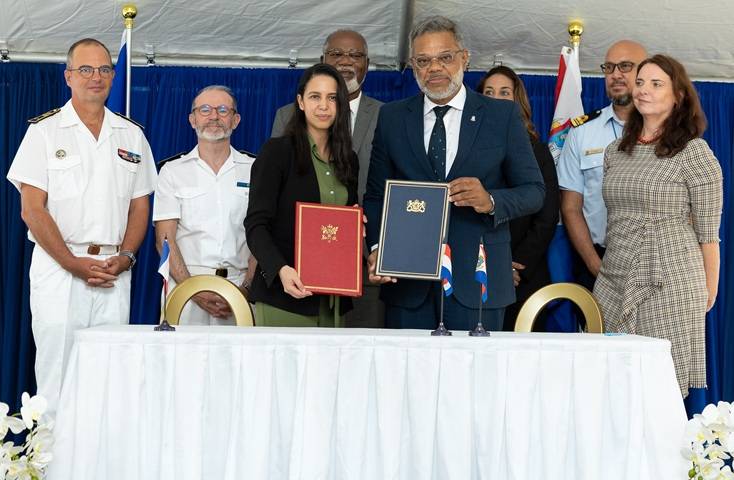
Prime Minister Dr. Luc Mercilina and The French Minister of Overseas Territories, Ms. Naïma Moutchou signed the treaty regarding “Hot Pursuit during Maritime Counter Drug Operations in the Vicinity of Saint Martin and Sint Maarten.”
Present were the Governor of St. Maarten Ajamu Baly, Minister of Justice, Natalie Tackling, the French side Prefect (Préfet), Cyrille Le Vély, and President of the Collectivité of Saint-Martin, Louis Mussington, among other dignitaries and invited guests.
Following remarks by French Minister of Overseas Territories Naïma Moutchou, Prime Minister Luc Dr. Mercelina addressed the gathering and reaffirmed the significance of the moment.
“Today we formalize an important agreement between the Kingdom of the Netherlands and the Republic of France regarding the mutual right of pursuit during maritime counter-drug operations in the waters surrounding Saint Martin and Sint Maarten,” the Prime Minister stated. “This moment is more than a signing ceremony, it is a clear and powerful statement of cooperation, trust, and shared responsibility.”
Prime Minister Dr. Mercelina highlighted the unique nature of the island and the need for close collaboration between both sides.
“Our island is unique in the world, two nations, two systems, two administrations, yet one people living side by side on a single island. That reality brings opportunities, but it also brings responsibilities. When it comes to protecting our borders, safeguarding our communities, and combating transborder crime, cooperation is not optional, it is essential.”
The Prime Minister explained that the agreement strengthens the legal framework that allows authorities to act decisively at sea.
“This treaty equips the Dutch Caribbean Coast Guard and the French Maritime Authority with the necessary legal instruments to pursue vessels engaged in illegal activities across maritime boundaries when circumstances demand it,” he said.
“In practical terms, criminals who attempt to exploit jurisdictional boundaries will no longer find refuge in the waters between our two territories. Our law enforcement partners will now have enhanced capacity to prevent, investigate, and prosecute violations of national laws, particularly those related to maritime drug trafficking.”
Prime Minister Dr. Mercelina also noted that drug trafficking has far-reaching consequences for communities.
“Drug trafficking is not simply a maritime issue. It threatens our youth, destabilizes our communities, and undermines the safety and prosperity that our people deserve. By strengthening our maritime cooperation, we strengthen the security of our island.”
He further emphasized that the treaty closes operational gaps that criminals have previously attempted to exploit.
“In essence, today we are closing procedural gaps that criminals once tried to exploit,” he stated.
Minister of Justice Nathalie Tackling opened the ceremony by welcoming the dignitaries and guests, and reflecting on the long history of cooperation between the French and Dutch sides of the island. She noted that since the signing of the Treaty of Concordia in 1648, two nations have shared one landmass where communities, economies, and cultures have grown together across what is often an invisible border.
The Minister explained that the treaty extends that same spirit of cooperation to the maritime domain, where criminal networks have at times taken advantage of jurisdictional boundaries. She noted that this treaty closes a gap criminals have too often relied upon.
She also recognized the many professionals and institutions who worked behind the scenes to bring this agreement to fruition and expressed her appreciation to the Dutch Caribbean Coast Guard and French maritime authorities, whose daily cooperation at sea gives real meaning to agreements such as this one.”
The French Maritime Authority, Capitaine de fregate Frederic Ollive gave a short speech then handed over to his counterpart to expound on the current situation of the Dutch Coast Guard of St. Maarten, Kapitein Ing. Randy Paskel.
The French Minister of Overseas Territories, Ms. Naïma Moutchou spoke afterwards, then the Prime Minister of Sint Maarten, the Honorable Dr. Luc Mercelina, expressed his pride in this day whereby both sides formalized an agreement in a clear and powerful statement of cooperation, trust, and shared responsibility.
The prime minister said that though two nations, two administrations, this reality brings opportunity and as well as responsibility to protect our borders and stop transborder crime.
This allows legal framework, the prime minister said, provide both the Dutch and French side maritime authorities with legal instruments to pursue criminal activities across maritime borders.
Combating criminal activity is not just a drug issue but it also affects our community. So this agreement strengthens our community.
After his speech, there was the signing of agreement documents between the Prime Minister Dr. and French Minister of Overseas Territories, Ms. Naïma Moutchou.
A toast was then occasioned to animate the signing.
The treaty establishes legal cooperation between the two authorities in maritime. Signatories have permission to enter/go after each other’s territorial sea during their patrols to conduct surveillance operations, exchange of operational information related to drug and other forms of trafficking in their jurisdictions.
The region, SXM strategic location, remains a point of transit of narcotics and weapons moving from South America toward North America and Europe requiring constant surveillance and high-speed interception capabilities. There are continued maritime counter-drug/illegal activities operations taking place with high-speed chases of Go-fast vessels. The aim is to stop smuggling, particularly of cocaine and marijuana and guns/weapons.