










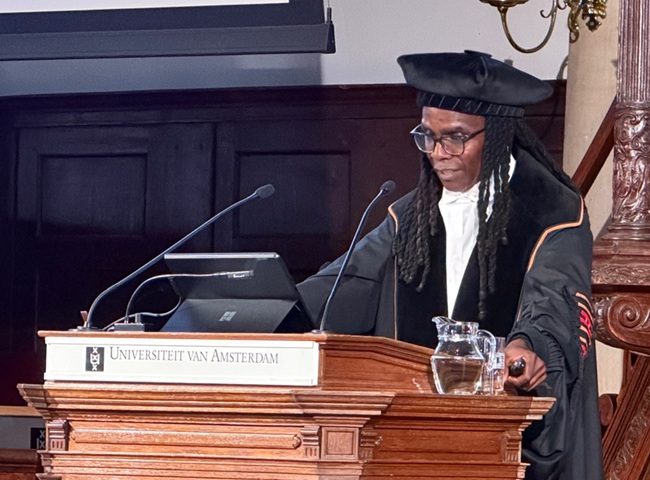
On Thursday 12 March, Prof Dr Francio Guadeloupe, Endowed Professor of Public Anthropology of Kingdom Relations, held his inaugural lecture at the University of Amsterdam (UvA). Guadeloupe held his inaugural lecture as holder of the Public Anthropology of Kingdom Relations chair. This chair was set up in 2024 by the Ministry of the Interior and Kingdom Relations (BZK).
During his inaugural lecture titled Dutch-Caribbean studies: Anthropological research of the Kingdom of the Netherlands, Guadeloupe argued that in the 21st century it is impossible to consider the Caribbean part of the Kingdom and the Netherlands as separate worlds, each with its own strictly defined ‘indigenous’ culture. This would underestimate how the life cycles of people within the Kingdom are intertwined on an everyday level.
Circular migration
Many people of Caribbean Dutch descent are part of a circular migration within the Kingdom: they live, study several years in the Netherlands, return to the islands to work and contribute there, and then migrate to the Netherlands again because there are more possibilities there. Psychologically, this group remains connected to both sides of the ocean. The reality of this circular migration and psychological connection is not widely known. The other way around, there are also people of Dutch descent who move to the islands or stay there a part of the year; they also call the Caribbean part of the Kingdom their home.
Research lines
Guadeloupe prepared a number of research lines for the chair that address the cultural and intellectual transatlantic connectedness and its impact on family ties and (romantic) relationships.
Anthropological film
As part of the chair, Guadeloupe has recently created an anthropological film, titled ‘Changá’ (‘Double Play’). The film invites the viewer to join the rhythm of the philosophy of dominoes: how do people respond to what life throws at them? Here, once again, the theme of identity features prominently. Changá premiered in Aruba and Curaçao last January. There will be further screenings in the Netherlands and on the other islands of the Caribbean part of the Kingdom.
Monitoring committee
The monitoring committee for the chair, also referred to as the curatorium, consists of chair Eileen Moyer, Professor of Anthropology of Ecology, Health and Climate Change at the University of Amsterdam; Rachel Spronk, Professor of Anthropology of Sexuality and Gender at the University of Amsterdam; Esther Captain, KNAW Special Professor of the Intergenerational Impact of Slavery and Colonialism at Utrecht University; and René Bagchus, Director of Kingdom Relations at the Ministry of the Interior and Kingdom Relations (BZK), as an advisory member.
Formally, for Guadeloupe, the inaugural lecture served as the acceptance of his position as Endowed Professor. An inaugural lecture is an important event with a great deal of ceremony. As usual, the inaugural lecture was attended by other professors, all dressed in academic robes.
Valuable
René Bagchus congratulated Guadeloupe on behalf of the Directorate General for Kingdom Relations of the Ministry of BZK. ‘I am pleased with the valuable contribution of Francio Guadeloupe towards the improvement of the Caribbean knowledge and how we live together within the Kingdom. I very much look forward to the further results of the research of Francio. I am convinced that his research and insights are going to contribute to a broader understanding and the connection within our Kingdom.’ Director General for Kingdom Relations, Barbera Wolfensberger, also attended the inaugural lecture.
Knowledge function
The Directorate General started two years ago with the development of a knowledge function related to Kingdom Relations, to base the policy concerning the six Caribbean islands more on Caribbean knowledge and know-how. That is why BZK initiated two Kingdom Relations chairs, of which Guadeloupe’s Public Anthropology of Kingdom Relations is one.