


















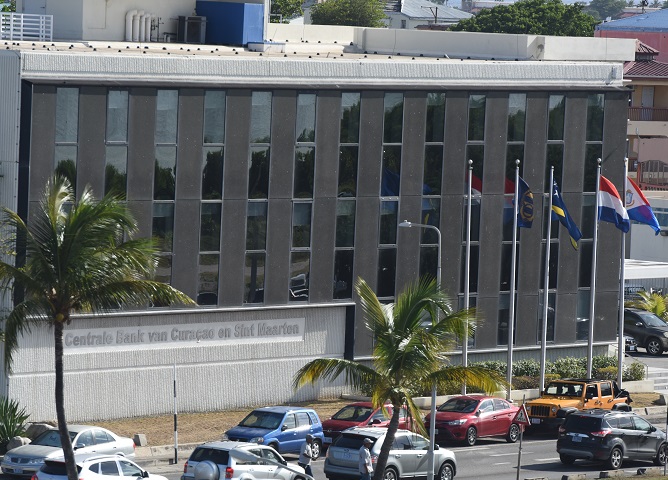
Willemstad/Philipsburg – On December 12, 2025, the Centrale Bank van Curaçao en Sint Maarten (CBCS) decided to ease its monetary policy stance. The CBCS reduced the pledging rate by 25 basis points to 4.25%, marking the second cut this year. This decision follows a reduction in the target range for the federal funds rate at the U.S. Federal Reserve in December 2025 and is supported by the monetary union’s strong foreign exchange position. Gross official reserves have increased significantly this year, and the average import coverage reached 4.8 months. However, rising geopolitical tensions, particularly in the region, could drive up import prices, undermine perceptions of the Caribbean as a safe travel destination, and affect capital flows into the monetary union. In light of the current uncertainties, the CBCS will closely monitor domestic and international economic developments and stands ready to adjust its monetary policy if needed.
According to the most recent estimates of the CBCS, the external position of the monetary union improved in 2025. The current account deficit of the balance of payments narrowed from 16.4% of GDP in 2024 to 11.4% in 2025. This improvement was driven by higher exports, mainly due to increased foreign exchange earnings from tourism and transportation services, and a decline in total imports. The reduction in the import bill is driven mainly by lower oil imports, consistent with the decline in average crude oil prices in 2025.
In line with these developments, gross official reserves also rose. They increased by Cg 274.4 million through November 14, 2025. By year-end, reserves are expected to have risen by Cg 230.9 million, as external financing and capital transfers from abroad are expected to exceed the current account deficit. Consequently, the average import coverage is projected to increase from 4.5 months in 2024 to 4.8 months in 2025, well above the norm of 3 months.
The current account deficit is projected to narrow further in 2026 to 10.3% of GDP. Gross official reserves are expected to continue to increase, although at a slightly slower pace of Cg 181.5 million. Meanwhile, the average import coverage will increase further to 4.9 months.
While the outlook is positive, the risks remain substantial and tilted to the downside. Although inflation in Curaçao is projected to decline to 2.1% and in Sint Maarten to remain stable at 1.8%, reflecting lower projected inflation in the monetary union’s key trading partners, global developments could still result in higher inflation. An escalation of the tensions between the United States and Venezuela could raise uncertainty over maritime security, disrupt trade, and increase shipping and insurance costs. It could also weaken the Caribbean’s reputation as a safe destination, reducing tourism and investor confidence. In addition, conflicts in the Middle East and the war in Ukraine continue to pose threats to global supply chains and commodity prices. These developments could drive up import costs, affect capital flows, and weigh on the monetary union’s external position.
Moreover, global trade prospects remain uncertain. Trade policy is highly sensitive to policy action and geopolitical developments. This uncertainty persists even though the tariff shock in 2025 was smaller than expected, partly due to front-loading by importers and recent agreements between the United States and key partners. However, uncertainty about how these agreements will be implemented, as well as ongoing legal challenges in the United States related to tariff measures, continue to cloud the outlook. This raises the risk of higher import costs and renewed supply
chain disruptions. For Curaçao and Sint Maarten, these developments could lead to higher inflation through more expensive imports and weaker foreign investment due to increased uncertainty.
In addition, domestic risks include climate related shocks, delays in public investment that constrain growth, and unresolved AML/CFT weaknesses that could disrupt financial activity. Furthermore, rising fiscal pressures from aging populations and healthcare costs in Curaçao and Sint Maarten could put pressure on government budgets, weakening public finances and threatening fiscal sustainability.
Against this backdrop, the CBCS has aligned its monetary policy with the Fed’s easing cycle. On December 10, 2025, the Fed reduced its target range for the federal funds rate to 3.50–3.75%, reflecting moderating U.S. economic activity and weakening labor market conditions, even as inflation has begun to edge higher. In line with this move, the CBCS decided to reduce its pledging rate, which is the rate at which commercial banks can borrow from the CBCS in case of a liquidity shortage, to 4.25%. With this, the CBCS remains 50 basis points above the federal funds rate. This decision is supported by the monetary union’s solid foreign exchange position and a careful assessment of global developments, while the Bank maintains a cautious policy stance.
At the same time, the CBCS will maintain the reserve requirement percentage unchanged at 18.50%. It will also continue to offer attractive rates on its weekly auctions of certificates of deposit (CDs), with the aim of holding more bank liquidity domestically, and thereby safeguarding the monetary union’s foreign exchange position.