

















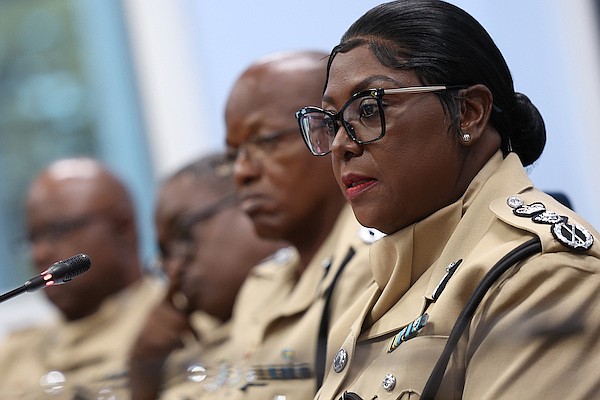
Police are considering adding non-lethal weapons to its arsenal because of the increasing number of Coroner’s Court jury ruling against officers in fatal shooting cases, Commissioner Shanta Knowles has revealed.
“I’ve started the process already, and I will be speaking with our minister a little further on about that,” she said, adding that such tools could become an important complement to firearms in the field.
Non-lethal weapons available to police forces range from tasers and stun guns to pepper spray and PAVA, a stronger synthetic version of pepper spray. Officers in some jurisdictions also use rubber bullets, bean bag rounds, and sponge grenades designed to disable suspects without killing them. Other tools include flashbangs, which disorient with light and sound, and newer “dazzler” devices that temporarily impair vision.
Commissioner Knowles’ comments followed last week’s Coroner’s Court finding that 27-year-old Dino Bain was unlawfully killed. He died after being shot by Reserve Constable Franklyn Armbrister during a December 2023 operation. Bain, who was unarmed, was shot once in the back while running from officers. The jury returned a “homicide by murder” verdict — the first such ruling against an officer since last year.
The verdict underscored a wider trend. Since 2023, juries have deemed 16 police-involved killings justified, eight homicides by manslaughter, and one — Bain’s — homicide by murder. Adverse findings, once rare, have become more frequent as the Coroner’s Court has more consistently heard police shooting cases. During this same period, the overall number of police-involved killings has also declined, placing the current debate over non-lethal options against a backdrop of greater scrutiny and fewer fatal encounters.
Commissioner Knowles said the ruling reinforced the need for officers to carefully consider the limits of justifiable force. “We will not encourage officers to abuse their power, but we encourage them to understand the justifiable force and harm policy, read upon it and continue to work with the Royal Bahamas Police Force as we create safer communities,” she said.
The Bain case gained attention after jurors were shown body-worn camera footage and security video contradicting the officer’s claim that Bain had a gun. Prosecutors confirmed no firearm was recovered. Medical evidence showed Bain was struck in the back while bent forward, consistent with him running away. Armbrister is in custody and must apply to the Supreme Court for bail, with the case referred to the Director of Public Prosecutions to decide whether criminal charges should follow.
Debate over equipping officers with tasers and other non-lethal weapons is not new. In 2020, then National Security Minister Marvin Dames announced that senior officials would meet with Arizona-based Axon Enterprise, makers of tasers, to explore their use. At the time, then Police Staff Association chairman Sonny Miller welcomed the idea but cautioned that new legislation and extensive training would be needed. He also admitted he was uncertain whether tasers would significantly reduce fatal shootings, noting that many stemmed from “very serious” armed confrontations.
In 2022, the issue resurfaced after the police killing of leading seaman Rodney Adderley. Deputy Commissioner Clayton Fernander said non-lethal weapons were “on the table”, though the proposal did not advance. That same year, National Security Minister Wayne Munroe said the decision ultimately rested with the Commissioner of Police but warned Bahamians could not expect officers to rely on non-lethal tools in violent situations. He also stressed that tight budgets required the government to prioritise spending.
Source:
By LYNAIRE MUNNINGS
Tribune Staff Reporter