
Willemstad/Philipsburg – Rising costs driven by demographic pressures, particularly an aging population, threaten the long-term sustainability of Curaçao’s health care system, according to a new study by the Centrale Bank van Curaçao en Sint Maarten (CBCS). The report analyzes medical expenditure, economic, and demographic data to project health care spending through 2050 under various scenarios. The findings are clear: if no substantial reforms are undertaken, Curaçao faces a sharp rise in health care costs, according to the author Djuwensi B. Passial, Economic Analysis & Research Specialist at the CBCS.
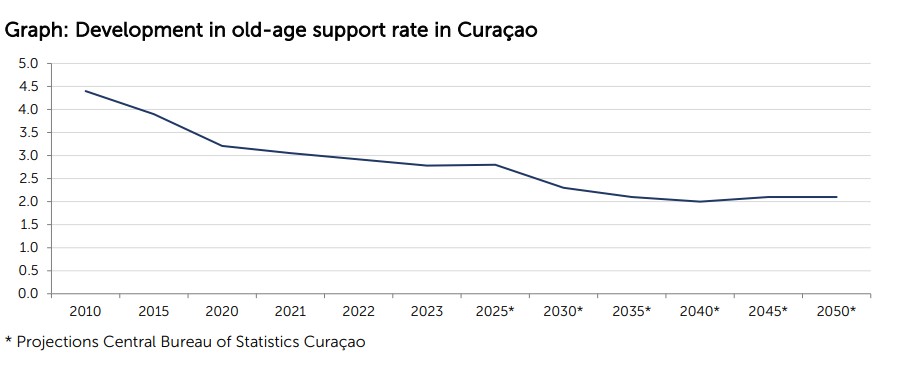
Healthcare spending in Curaçao has outpaced both inflation and government revenue growth for the greater part of the past decade, raising structural concerns. The country already allocates a relatively high share of its GDP to healthcare, comparable to high-income economies, despite having limited fiscal space. At the same time, the population is aging rapidly. By 2050, the share of individuals over 65 is expected to nearly double, while the old-age support ratio will fall from 3.9 to 2.0. The old-age support ratio measures the number of working-age people (15 – 64 years) for every person aged 65 or older. A declining ratio indicates fewer workers available to support each elderly person, increasing healthcare costs and fiscal pressures.

Projections indicate that by 2050, healthcare costs will increase by 41–42% based on demographic change alone, and by over 140% when price inflation is included. The ageing population is raising both the volume and cost intensity of care, with spending increasingly concentrated among older age groups.
For this study, a cohort-based projection model was used to project healthcare expenditure. The model divides the population into five-year age groups (i.e., cohorts) and sex, using demographic projections by the Central Bureau of Statistics Curaçao (CBS) as the estimate for the future population structure. Healthcare cost data provided by the Social Insurance Bank (SVB) were then applied to project costs under two scenarios, one reflecting demographic change alone, and another incorporating price inflation. This method provides a structured yet conservative estimate of Curaçao’s future healthcare costs pressures.
The study also proposes three policy interventions to address these challenges. First, reshape population dynamics by attracting working-age migrants to expand the pool of contributors. Second, mitigate age-related healthcare costs through a national preventive health strategy focused on early diagnosis, healthy living, and community care. Third, broaden the system’s revenue base through fair co-payment mechanisms and health-related taxes, creating a more resilient and equitable funding model.
While the study does not include long-term care (AVBZ) or future medical innovations, which could further increase costs, it makes clear that Curaçao’s healthcare system is at a tipping point. Decisive action is needed to ensure quality care and equitable access for future generations.
The CBCS thanks the SVB for providing the healthcare costs data used in this analysis. The full working paper is available at https://www.centralbank.cw/functions/research.