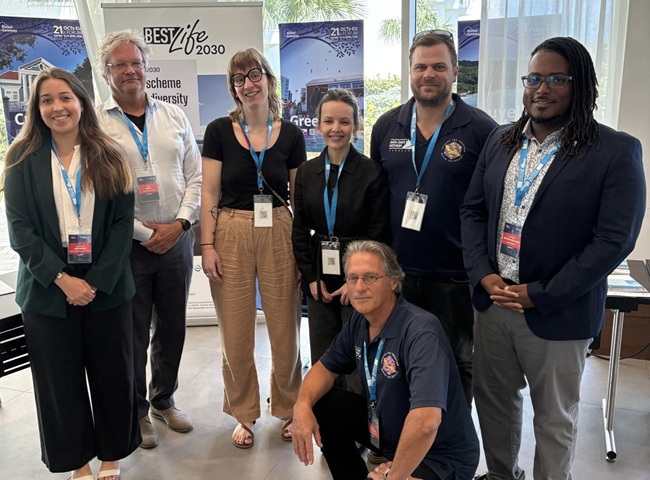
PHILIPSBURG, SINT MAARTEN – The Nature Foundation Sint Maarten, a local environmental conservation non-profit, was among a small group of delegates at the high-level OCTA Ministerial Conference on April 11 in Aruba, to present on the need for increased, long-term biodiversity funding across Overseas Countries and Territories (OCTs). Part of the 21st OCTs-EU Forum, the occasion allowed beneficiaries of the BESTLIFE2030 Programme to communicate directly with top-ranking ministers and regional authorities of OCTs, the European Commission, Member States, and regional stakeholders.
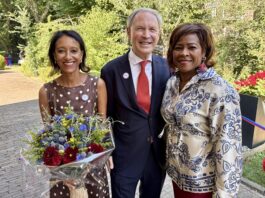
Project Manager Sabrine Brismeur, a resident of Saint-Martinois parentage, represented the Nature Foundation alongside three other program beneficiaries from Aruba, Curaçao, and Sint Eustatius, along with IUCN BESTLIFE2030 coordination team. Over the course of an hour, the group made the case for why the EU must continue to scale up investment in biodiversity initiatives in the OCTs, drawing on their direct experience implementing various projects.
The invitation also served as an opportunity for the Nature Foundation to share its experience and feedback on BESTLIFE2030 directly with its coordinators. EU-funded programs like BESTLIFE2030, while incredibly valuable, are noted for their rigorous administration and reporting requirements, which can be difficult for small, capacity-strained organizations to meet. Communication and relationships between on-the-ground practitioners and high-level grant administrators are essential to improving the conditions and outcomes of successful projects.
“These sorts of programs are critical to our work on Sint Maarten and allow us to carry out projects that are innovative, targeted, or long overdue,” said Brismeur. “Funding for biodiversity conservation among our islands is low, especially for extremely small NGOs like the Nature Foundation — which does not benefit from sustainability or nature fees, head taxes, environmental fines, or even nature park entry tickets, since we are the only island in the Dutch Caribbean without a terrestrial park.”
Programs including BESTLIFE2030 — a grantmaking mechanism focused on preserving and restoring biodiversity in the EU’s outermost regions (ORs) and OCTs — are funded by the EU to advance shared global biodiversity commitments. Through the Kingdom of the Netherlands, Sint Maarten is party to various treaties including the Specially Protected Areas and Wildlife (SPAW) Protocol and the 30×30 targets of the Convention on Biological Diversity (CBD).
“Biodiversity conservation is not just about wildlife itself, but about how species and ecosystems help sustain economies, generate savings, feed populations, improve health, protect infrastructure, and root culture,” said Brismeur. “For example, our project ties together the capacity of sustainable fisheries and elasmobranchs – sharks and rays – to provide long-term benefits for our local fishers.”
The Nature Foundation would like to sincerely thank the coordinators of IUCN BESTLIFE2030 Programme and OCTA for the invitation and opportunity, as well as the policymakers, politicians, and civil servants present in the room for listening and considering the presentation.
The Nature Foundation’s BESTLIFE2030 project, MENAA (Marine Elasmobranch Nursery Area Advocacy), seeks to build a foundation for the long-term success of Sint Maarten’s marine and coastal areas, particularly for sharks and rays. Research shows that local waters serve as a nursery for species including tiger sharks, Caribbean reef sharks, and spotted eagle rays. These animals are crucial for reef health and fishery stability but remain threatened by poaching and ghost nets, despite existing local protections. Learn more about the program at https://naturefoundationsxm.org/projects/menaa.
The BESTLIFE2030 Programme is co-funded by the European Union. Views and opinions expressed are, however, those of the author(s) only and do not necessarily reflect those of the European Union or CINEA. Neither the European Union nor the granting authority can be held responsible for them.