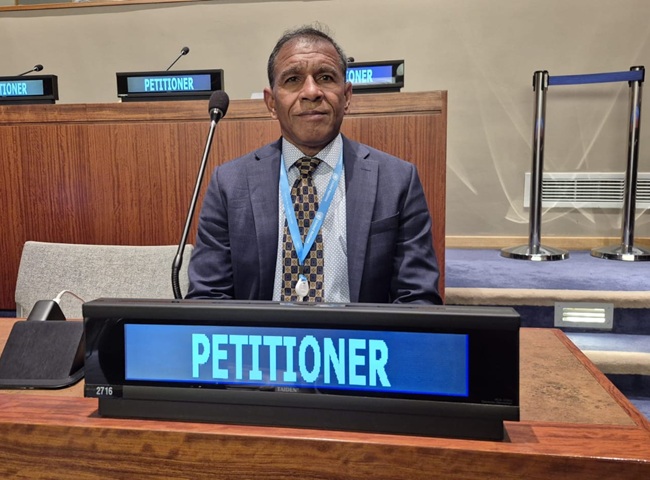
James Finies, founder of the Bonaire Human Rights Organization and leader of Partido Pueblo Progresivo, has issued an objection letter to Bonaire’s Lieutenant Governor, Mr. John Soliano, expressing concern over proposed Dutch legislation that would empower the Lieutenant Governors of Bonaire, Sint Eustatius, and Saba to order the removal of online content deemed to threaten public order. Finies expresses that granting such powers to a single appointed, non-democratically elected official—without prior court authorization or involvement of the justice system—would place powers resembling those of a colonial administrator or authoritarian ruler, rather than those expected in a democratic society governed by the rule of law.
Finies’ open letter to Lieutenant Governor Soliano was a follow up of his earlier Letter of 28 June 2026, addressed to the Prime Minister of the Netherlands, the Minister of Justice and Security, Members of the Dutch Parliament, Human Rights Council, expressing serious concern over expanding Dutch criminal legislation on criminalizing the glorification of terrorism and public expression in Bonaire.
Saba, with a population of approximately 2,000, Sint Eustatius, with approximately 3,000, and Bonaire in 2004 with about10000 people now in 25000 thousand inhabitants, have long remained peaceful and hospitable Caribbean communities with no significant terrorist activity that would justify such sweeping restrictions. The UN Special Rapporteur on Counter-Terrorism and Human Rights has repeatedly warned that overly broad terrorism laws can suppress dissent, restrict civic participation, criminalize legitimate political expression, and must never be used to justify expanding state control over public discourse or undermining fundamental freedoms.
Finies stresses that the issue extends far beyond social media. The people of Bonaire have seen their democratic choice and collective decision silenced, their human rights denied, and their island placed under external governance in a constitutional status they did not freely choose. The people of Bonaire remain governed from The Hague without an effective voice or representation in the decisions that shape their laws, institutions, rights, and future.
As Bonaireans endure this continuing marginalization, Finies asks why Dutch laws imposed from The Hague are consistently treated as paramount by Bonaire’s public authorities, while international human rights law and treaty obligations binding upon the Kingdom of the Netherlands are neither considered nor respected.
Public question to Lieutenant Governor Soliano:
“Who do you serve? Do you primarily defend and enforce laws enacted by Dutch politicians thousands of kilometers away, or do you equally uphold the democratic rights, human rights of the people of Bonaire under the Charter of the United Nations, international law, and international human rights treaties?”
Finies notes that even within the Netherlands, the proposed legislation has generated constitutional concerns. The Dutch House of Representatives’ Temporary Committee on Fundamental Rights and Constitutional Review has warned that the proposal affects freedom of expression and the right to demonstrate and therefore requires stronger legal safeguards.
Finies recalls that Articles 19 and 25 of the International Covenant on Civil and Political Rights, together with Articles 19 and 21 of the Universal Declaration of Human Rights, protect freedom of expression and participation in public affairs. Any restriction must be lawful, necessary, proportionate, and consistent with international human rights standards.
Respect for the rule of law requires more than enforcing legislation imposed by Dutch politicians in The Hague. It requires equal respect for the democratic will of the Bonairean people, their right to participate in governance, and the higher obligations arising under international law and human rights treaties binding upon the Kingdom of the Netherlands.