
PHILIPSBURG, Sint Maarten — The influence of colonial structures on environmental governance in the Caribbean was the focus of a presentation by Sint Maarten environmentalist Tadzio Bervoets at the recent Caribbean Studies Association Conference.
Presenting on “Conservation Colonialism and the Persistence of Fortress Management in the Dutch and French Caribbean,” Bervoets argued that many conservation systems operating in the Dutch and French Caribbean remain shaped by governance models that concentrate authority outside the region. According to the presentation, these arrangements often limit local decision-making, restrict community participation, and reduce opportunities for Caribbean leadership within environmental institutions.
The presentation examined how environmental policies, technical expertise, and management frameworks continue to be influenced by metropolitan governments and external institutions. While acknowledging the significant contributions that conservation organizations have made to biodiversity protection, marine management, and ecosystem restoration throughout the Caribbean, Bervoets raised concerns that some conservation initiatives continue to reflect historical patterns of authority that marginalize local communities and institutions from decision-making processes.
Central to the discussion was the concept of “conservation colonialism,” describing the persistence of colonial relationships within modern environmental management systems. The presentation also explored the concept of “fortress conservation,” a model that emphasizes environmental protection through exclusionary approaches, enforcement mechanisms, and externally determined priorities rather than through collaboration with local communities.
Drawing on examples from across the Dutch and French Caribbean, Bervoets noted that many environmental institutions continue to rely heavily on external leadership, donor-driven priorities, and governance structures originating outside the region. He argued that these factors can weaken local stewardship, limit professional advancement opportunities for Caribbean conservation practitioners, and reduce the integration of traditional and community-based knowledge into environmental planning and management.
The presentation further highlighted that concerns regarding local capacity are often linked to structural barriers rather than any inherent limitations within Caribbean societies. According to Bervoets, leadership opportunities, institutional authority, and long-term investment in local expertise are essential for building stronger conservation institutions that are responsive to local realities and priorities.
Alternative approaches emerging elsewhere in the Caribbean were also discussed. Examples from fisheries co-management initiatives in Jamaica, collaborative marine protected area governance in Belize, and Indigenous stewardship systems practiced by communities throughout the region were highlighted as evidence that locally led conservation can achieve positive environmental outcomes while strengthening community participation and accountability.
Bervoets called for greater investment in Caribbean leadership, increased institutional autonomy, expanded community co-management frameworks, and stronger recognition of Indigenous, Afro-Caribbean, and local ecological knowledge within environmental decision-making processes. He argued that conservation efforts are most effective when the people most closely connected to natural resources play a meaningful role in determining how those resources are managed and protected.
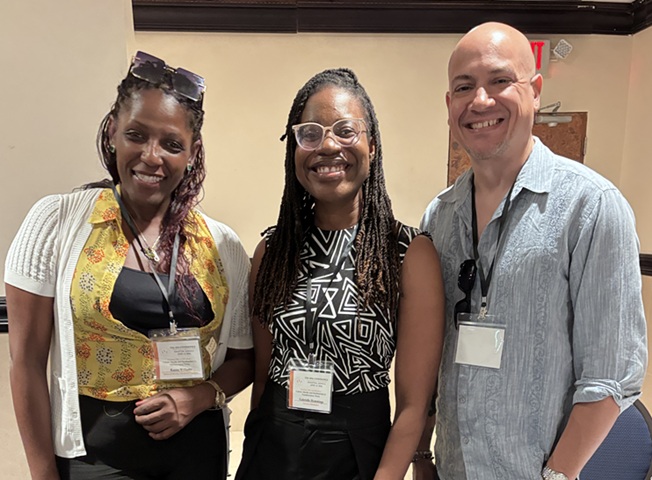
The session formed part of a broader panel examining the afterlives of empire and their influence on contemporary Caribbean governance and development. Fellow presenter Gabrielle Hemmings of the University of Birmingham explored the impact of reparatory justice initiatives undertaken by United Kingdom higher education institutions and their implications for the Caribbean. The discussion was chaired by Dr. Roana Williams, who facilitated an exchange on governance, justice, and self-determination in the Caribbean.
The session highlighted growing interest among Caribbean scholars and practitioners in examining how historical power structures continue to shape environmental and development challenges. Participants emphasized that achieving long-term resilience in the Caribbean will require governance models that place greater authority, expertise, and decision-making responsibility within the region while ensuring that conservation remains both effective and locally legitimate.