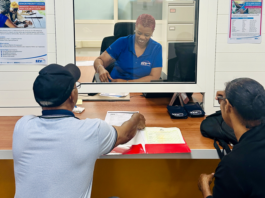

POND ISLAND, St. Maarten — The Ministry of Tourism, Economic Affairs, Transport and Telecommunication (TEATT) has finalized the 2026 Passenger Transport Confirmation Process and will now move fully into the enforcement phase aimed at strengthening compliance, accountability, and professionalism within the public transportation sector.
As previously communicated through public notices and earlier press releases, the Ministry executed a two-phase confirmation process to ensure that all public transportation operators were given a fair and adequate opportunity to regularize their status and comply with the requirements established under the Passenger Transport Ordinance.
Minister of TEATT Grisha Heyliger-Marten said at Wednesday’s Council of Ministers Press Briefing that the process was not simply administrative, but part of a broader effort to restore structure and accountability within the sector.
“Permit holders are not merely license holders. They form part of a regulated national transportation system and are expected to operate responsibly, professionally, and in compliance with the law,” the Minister stated.
Under the ordinance, operators are expected to operate within permit conditions, maintain valid operational documentation, ensure vehicles meet required standards, provide safe and reliable transportation services, and contribute to an organized and accountable transportation network.
The Ministry also released updated figures reflecting the current status of the sector.
Within the bus category, which includes both individual and company permits, 354 permits remain on file at the Inspectorate of Economic and Transport Affairs (IETA). Of that number, 138 operators completed the confirmation process in 2025, compared to 127 operators in 2026.
For taxi operators, 683 permits remain on file at IETA. In 2025, 455 operators completed the confirmation process, while 400 operators completed the process for 2026.
Within the touring car and unregulated category, 149 permits remain on file. Confirmation figures declined from 47 operators in 2025 to 40 operators in 2026.
The car rental category recorded 35 confirmed operators for 2026, despite only 28 permits currently reflected on file at IETA. According to the Ministry, this number may ultimately be higher due to certain operators becoming active in 2026 while not yet fully reflected within existing records.
The Ministry noted that the figures demonstrate a significant gap between permits on file and operators who completed the required annual confirmation process.
The Ministry said that payment alone does not grant authorization to operate.
Operators who may have paid fees but failed to complete the confirmation process are not considered fully compliant. The confirmation letter remains the official validation authorizing operators to legally function for the year.
“Without this process, the system becomes unregulated, unfair to compliant operators, and potentially unsafe for the public,” the Ministry stated.
Effective immediately, the Ministry will transition fully into the enforcement phase.
Operators who failed to comply within the established timeframe may now face permit review, suspension or revocation procedures, increased roadside inspections, enforcement action under applicable regulations, and referral into the upcoming Public Transportation Committee (PTC) review framework.
The Ministry described the move as a clear transition from facilitation to accountability.
As part of the broader restructuring effort, TEATT is also continuing work toward a more coordinated transportation oversight framework involving the Inspectorate of Economic and Transport Affairs (IETA), the Transport Control Unit, and the soon-to-be-established Public Transportation Committee (PTC).
According to the Ministry, the objective is to improve compliance, operational oversight, and service reliability across the transportation sector.
“This is ultimately about fairness,” Minister Heyliger-Marten stated. “Fairness to operators who follow the rules, fairness to passengers who expect safe transportation, and fairness to a country that depends on professionalism within one of its most visible service sectors.”