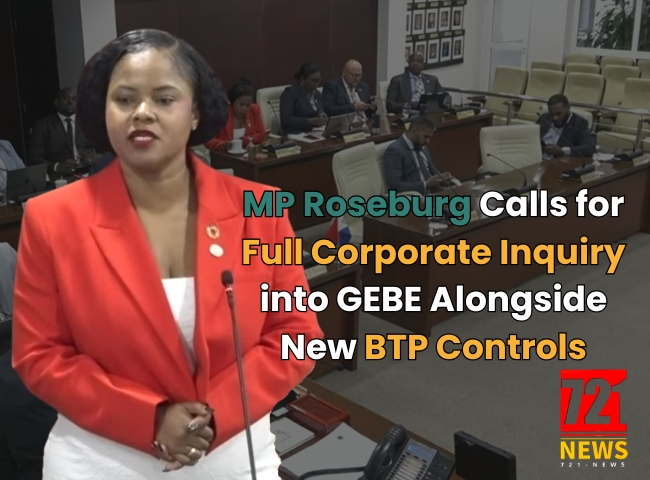
PHILIPSBURG, SINT MAARTEN — After sending a formal advisory letter to the Council of Ministers, MP Sjamira D.M. Roseburg, LL.M., is calling on the government as 100% shareholder to immediately petition the Common Court of Justice to open a corporate inquiry procedure (enquête procedure) for NV GEBE.
Roseburg insists this judicial track should go alongside the regulatory initiatives already being executed by the Ministries of TEATT and VROMI.
If the Council doesn’t move forward with this inquiry procedure, she warns, that history might repeat itself. She hereby refers to the start of the inquiry procedure of the harbor in 2017.
She fully commends the steps both Ministers have taken, in regards to coming to the newly published decree giving Bureau Telecommunicatie en Post (BTP) oversight.
The Court Inquiry is seeing the current status and the lack of transparency and accountability much needed. The procedure opens the black box of the past years to see where it went wrong and who is to be held responsible, with the goal to permanently clean up the corporate foundation.”
NV GEBE has not met its statutory duty to maintain proper administration or file audited financial statements on time, a structural administrative gap (structureel administratief gat) that demands a judicial answer. The judicial inquiry is the last resort to audit why the billing system is still failing, how and if the fuel clause was ( fairly ) calculated, ensuring absolute transparency for consumers who have been left in the dark.
It should be noted that only a Selective Group Can Act
Under Caribbean corporate law, only the Shareholder (the government), the corporate boards, or the Public Prosecutor can file for a Court Inquiry. Individual citizens and Parliament have no standing.
That places the responsibility squarely on the government as 100% owner.
Roseburg points to two regional precedents to make her case. In Curaçao, when Aqualectra faced severe financial distress from past mismanagement, the government acted as shareholder, partnered with stakeholders, and launched the inquiry themselves, successfully cleaning up the utility while keeping full control of the process. The contrast with Sint Maarten’s own 2017 harbor situation could not be starker. There, the government stayed passive. Because the shareholder didn’t act, the Public Prosecutor stepped in on public interest grounds, forcing an inquiry and completely sidelining the government in its own company.
“We must absolutely prevent a repeat of the Harbor scenario,” Roseburg warns. “It is constitutionally, democratically, and administratively far cleaner if the government takes responsibility and requests this investigation itself.”
Truth-Finding, Not Finger-Pointing
Roseburg is clear this is about facts, not politics. “The administration does not lie and the books must speak for themselves.” The company’s current state, she says, is the result of years of sheer neglect.
If the Court identifies manifest mismanagement, the consequences can be severe and personal. Under the Civil Code, former and current executives such as past CEOs, COOs, CFOs, or supervisory commissioners who caused or enabled the financial and administrative chaos can be held personally liable in their private assets.
Roseburg is awaiting a formal written response from the Council of Ministers on their willingness to submit the petition to the Common Court of Justice.