
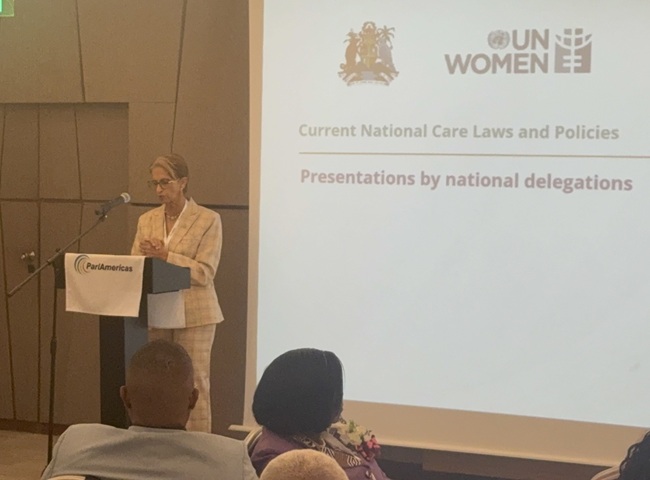
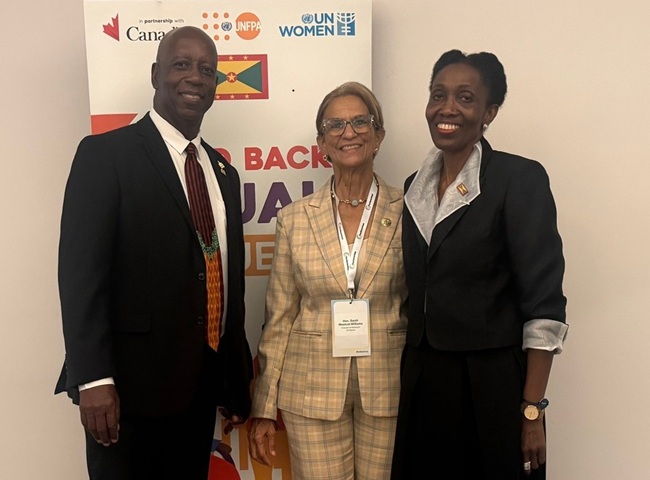
GRENEDA / SINT MAARTEN – Last Thursday and Friday, President of Parliament, MP Wescot-Williams led the Sint Maarten parliamentary delegation at a workshop hosted by Parlamericas in Grenada, focused on one of the most fundamental yet overlooked pillars of Caribbean economies: paid and unpaid care work.
Reflecting on the engagement, MP Wescot -Williams noted that the discussions brought into sharp focus a persistent reality; economies across the region are sustained not only by what is formally measured, but also by what remains largely invisible.
Care work, in all its forms, underpins the functioning of societies. It encompasses raising children, supporting the elderly, caring for the sick, and maintaining households. Despite its essential nature, such work continues to be undervalued, underpaid, and in many instances, unrecognized across the Caribbean, the MP further stated.
The workshop highlighted that unpaid care work is disproportionately carried by women. This imbalance has direct economic implications. When women dedicate significant time to unpaid caregiving, their participation in the formal economy is constrained, affecting income, career progression, pension accumulation, and long-term financial independence.
For Sint Maarten, these challenges are particularly pronounced. Limited public services, high living costs, and fragmented social support systems often result in families absorbing the burden of care privately, frequently placing that responsibility on women.

“While the concept of unpaid care work may at first seem abstract, its reality is deeply personal. Consider a family caring for an elderly parent living with dementia, in a context where institutional care is unavailable. Household help may be present, but without the specialized training required to manage such a condition. Professional care, where it exists, is often financially out of reach. In these circumstances, the responsibility falls squarely on family members, often adult children who are themselves parents, working or running small businesses.
The physical, emotional, and financial strain that results is immense, and it is precisely this lived reality that underscores why recognizing and supporting care work is so critical.
MP Wescot-Williams iterated that in the Democratic Party’s 2024 political manifesto, the care economy is outlined as a key pillar for Sint Maarten’s future development. The discussions in Grenada reinforced the urgency and relevance of this policy direction.
The workshop also examined the conditions of paid care workers, including those in early childhood education, elder care, care for the disabled and domestic work. The resulting paradox is clear: the work that sustains societies remains among the least valued in economic terms.
In light of the discussions, MP Wescot-Williams underscored the need for a shift in policy approach. Recognizing care as a public good will require strategic investments in childcare, eldercare, and community-based support systems. Such investments are not merely social expenditures, but critical enablers of economic participation and productivity.
Further, the importance of making unpaid care work visible was highlighted, particularly through improved data collection and the use of time-use surveys to better inform policymaking.
Improving the conditions of paid care workers must also be prioritized through fair wages, formalization of employment, access to social protection, and recognition of care work as skilled labor. Additionally, a more equitable distribution of care responsibilities within households, communities, and through public policy was identified as essential to advancing gender equality.
As Caribbean societies confront aging populations, evolving family structures, and increasing economic pressures, the demand for care services is expected to grow significantly. Without targeted interventions, existing inequalities are likely to deepen.
Despite these challenges, the engagement in Grenada was described as constructive and forward-looking. Parliamentarians from across the region demonstrated a shared commitment to placing care at the center of policy discussions.
The focus now, the President of Parliament noted, must be on translating dialogue into concrete action.