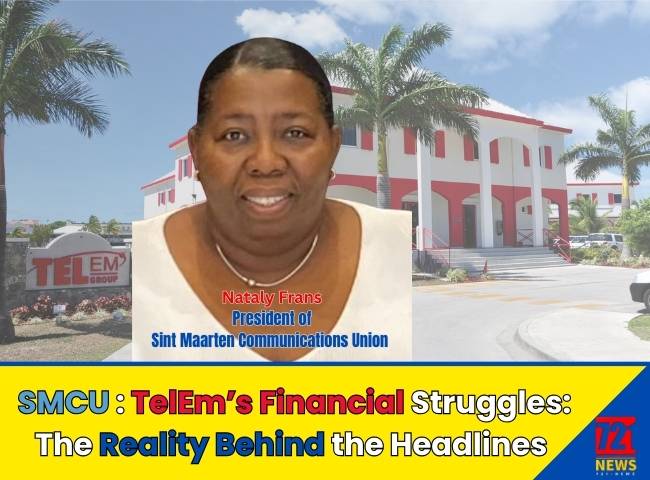
Philipsburg, Sint Maarten — Recent media reports suggest that TelEm is almost financially stable and moving forward with major upgrades. The reality, however, is very different. The company is in a serious financial crisis, which has forced it to restructure operations and send employees home twice and yet Telem is facing financial difficulties.
Under the management of former Acting CEO and CFO Helma Etnel, and the present Board members, Telem has faced severe financial challenges. From the beginning, the Fiber to the Home Project was set on an unsustainable path when management chose to exclude Telem’s technicians from contributing to this vital initiative.
Telem was ordered to pay US$3,746,738.71 to MER, following an arbitral award upheld by the Dutch Supreme Court. This amount covers compensation for work completed by MER under their Fiber-to-the-Home contract, arbitration fees, and legal expenses incurred by MER. The dispute arose after Telem wrongfully terminated the contract and improperly exercised the associated bank guarantee. The arbitral tribunal ruled entirely in favor of MER, dismissing all of Telem’s counterclaims.
Following the termination of its agreement with MER, Telem contracted KNC Networks to continue the Fiber-to-the-Home (FTTH) project. In December 2021, Telem technicians and contractors completed a specialized FTTH technical training course to prepare for the network rollout. Telem’s CEO, Kendall Dupersoy, stated that the internal team would take responsibility for completing and maintaining the FTTH infrastructure, ensuring continuity of service and local oversight.
St. Maarten News, August 11, 2020.
The press release further stated that Telem’s existing bond and the 44 million ANG loan provided by the Windward Island Bank were at risk, with potentially dire consequences for the future of Telem and its employees. Despite significant cash investments into the Fiber-to-the-Home project, the initiative was not completed, leaving the company burdened with debt and exposing both its operations and workforce to financial uncertainty. The article highlights that Telem had secured a loan for the FTTH project in 2015. However, instead of utilizing the loan for its intended purpose, Telem refinanced it under more favorable terms and redirected the funds to cover other expenses. This financial maneuver led to a situation where Telem was not paying the Bureau Telecommunication and Post (BTP) as required, despite fulfilling its obligations to the government. The settlement agreement between Telem and BTP allowed Telem to continue operations under a new concession agreement, but it did not address the underlying financial issues, such as the unpaid concession fees owed to the government.
Fast forward the media has made the effects of those choices clear. SMN-News (Sept. 2024) revealed that “APS pulled out of the loan negotiations, citing the company’s lack of long-term leadership.” According to SMN-News (Aug. 2025), Telem is “collapsing under years of mismanagement and corporate incompetence.” An MP revealed that “44 million guilders in loans” were taken for fiber, yet “large areas of the country still lack coverage.” At the same time, The People’s Tribune (Aug. 2025) warned that “jobs are at risk” as Telem struggles under growing debt while facing competition from Starlink.
Here’s what was stated in the two People’s Tribune articles regarding TelEm’s turnaround strategy and where it stands relative to competition like Flow and Starlink:
- “TelEm: Digging itself out of a hole” (Part 1)
Key Statements on Turning Around the Financial Situation:
- Asset divestment as strategic restructuring:
- TelEm intends to sell its headquarters and the former Cable TV building in Madam Estate to “restructure the balance sheet”, using proceeds to reduce exposure to lenders and fund investments. This is not considered a “sell-out” but rather a deliberate strategy, pending board and lender approval.
- Self-financed network investments:
- No new loans have been taken instead, existing operational cash flow is being used to invest systematically in both fixed and mobile networks. The rationale: updating the network is essential to remain competitive.
- Addressing cash-flow pressures:
- While there are vendor complaints about late payments, the company assures that “eventually everybody is being paid”. Once the network is fixed, cash flow is expected to improve, and rumors of bankruptcy are explicitly dismissed as false.
- Seeking government support:
- As a government-owned entity, TelEm’s access to shareholder assistance is complex. They have submitted a “Quick Scan” to the government, and are awaiting a response on possible assistance.
- “Telem Responds to union: ‘We Are Moving Confidently Into the Future’” (part 2)
Statements on Strategy and Competitive Positioning vs. Flow and Starlink:
- Proactive modernization before Starlink’s entry:
- TelEm’s transformation is part of a long-term modernization plan, not a reaction to new competitors. In April 2025, they rolled out ultra-fast fiber packages island-wide—offering 250 Mbps download / 100 Mbps upload, exceeding Starlink’s upload speeds, without raising prices (starting at US $55/month).
- Advancing toward 5G:
- In June 2025, TelEm deployed a new mobile core, laying the groundwork for island-wide 5G coverage expected by Q1 2026.
- Debt-free modernization through efficiency:
- Unlike many regional operators, TelEm is upgrading without incurring new loans, relying instead on cost reductions, efficiency improvements, and strategic partnerships to secure long-term sustainability.
- Commitment to local resilience and infrastructure:
- As Sint Maarten’s only locally owned provider, TelEm highlights its role in creating jobs, investing in local infrastructure, and building national resilience, especially in contrast to global operators like Starlink.
- Concrete priorities ahead:
- TelEm outlined clear upcoming objectives:
- Complete the island-wide broadband rollout
- Deliver 5G technology
- Improve reliability and customer service
- Protect local jobs
- Maintain affordable and stable pricing
- Their overarching strategy is described as “ambitious, sustainable, and rooted in serving the people of Sint Maarten”.
- TelEm outlined clear upcoming objectives:
TelEm’s management has laid out a multi-pronged recovery strategy:
- Financial restructuring via asset sales and internal cash flow.
- Network modernization (fiber rollout and 5G), achieved without new borrowing.
- Local focus and resilience, stressing that their services beat or match Starlink’s in key metrics like upload speed, while supporting the island’s economy.
TelEm has announced plans for network improvements, including faster fiber internet and preparations for 5G, claiming the company will be “back on track” in 2026. But these claims raise important questions. If the time frame for these investments are realistic and the company have a solid plan, why were employees sent home, and why weren’t these plans implemented sooner?
The company has not received the much needed cash injection from the government, and loans from the unfinished fiber project continue to weigh heavily on its finances. In addition, TelEm still has other unpaid debts, further limiting its ability to invest in operations or stabilize the company.
The SMCU is urgently pleading with our local government not to issue work and residence permits to foreign workers while Telem has sent our local technician’s home and now to hire Colombians and potentially other foreign nationals to perform work in St. Maarten. None of these foreign workers contribute to our local tax system or social security (SZV) funds, and consultants who work remotely similarly do not pay into these systems. The union also notes that Telem is in the process of hiring a new Chief Commercial Officer (CCO), which will likely require a work and residence permit.
SMCU emphasizes that the government must not repeat the mistakes of past administrations by neglecting Telem. Instead, it should give Telem its full attention to safeguard and revitalize our local company. We can do it. We have capable professionals who can put Telem back on a profitable and competitive track. It is time to believe in us.
Now, it is time to trust our people and our expertise. Protecting and empowering our local workforce is essential for the sustainable future of Telem.
The Minister of Finance is now tasked with overseeing Telem, and the SMCU expresses its full support, to assist in revitalizing the company, protecting it, and preventing further financial challenges. The union emphasizes that the Fiber-to-the-Home (FTTH) loan is real, and despite significant investment, the FTTH project was never fully completed, leaving Telem burdened with debt and operational challenges. SMCU stands ready to collaborate to ensure Telem’s stability, safeguard local jobs, and restore the company to a profitable and competitive position.